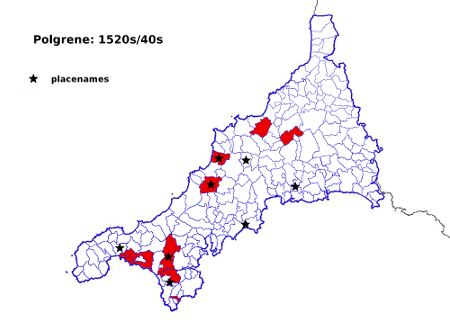
Polgrean is a Cornish placename meaning gravel pit. It’s hardly uncommon, cropping up in at least eight parishes from Ludgvan in the west to St Veep in the east. By 1861 Polgreans were confined largely to West Penwith, with just single Polgrean households at Falmouth and St Germans. But in the seventeenth century there were many more Polgrenes in mid-Cornwall, which suggests multiple origins. Indeed, if we look at the earliest records, we find Polgrenes at St Mawgan, Newlyn East and at Wendron in the west, all parishes with this placename. Moreover, a cluster of Polgrenes east of Ludgvan and another instance on the Lizard strongly imply that Ludgvan and Cury were also origins of this surname.
Rabling is also a western surname, but more obscure. It seems to have arisen in the Camborne district somewhere between the mid-1600s and the early 1700s. It looks to be a diminutive form of Robert, via Rab – like Tamlyn, from Thomas. There is just one early example, Elinora Rablin, who was married at St Teath in 1587. This is miles away from Camborne and the absence of other Rablins implies there was no direct link.
Even more obscure is Raddall. The surname dictionaries suggest this might be a spelling of Redhill (a place in Surrey). It doesn’t seem likely that this explains John Redell’s name at Newlyn East in 1524. Reddel was found occasionally in mid-Cornwall thereafter, a John Redell being baptised at St Enoder in 1578, while the surname was present at Lanivet in 1641. But was there a link between these and the Redells and Radells found at Callington and south east Cornwall in the late 1500s? Furthermore, Raddles at Lezant near Launceston appear to be the origin of the nineteenth century Raddalls. Family history is required to connect all these up, if indeed they are connected. And is there any connection with the east Cornish (and Devonian) name Rodd? Were all of them originally from the same first name?
 Cornish studies resources