Situated in the north coast of mid-Cornwall, St Merryn is now part of Cornwall’s supposed honeypot tourism periphery, with a high number of second homes and holiday cottages. As much as 60-70 per cent of the housing stock in the coastal areas of the parish had no permanent resident in 2011. We’re still waiting for the 2021 census results to tell us if this proportion has grown or not.
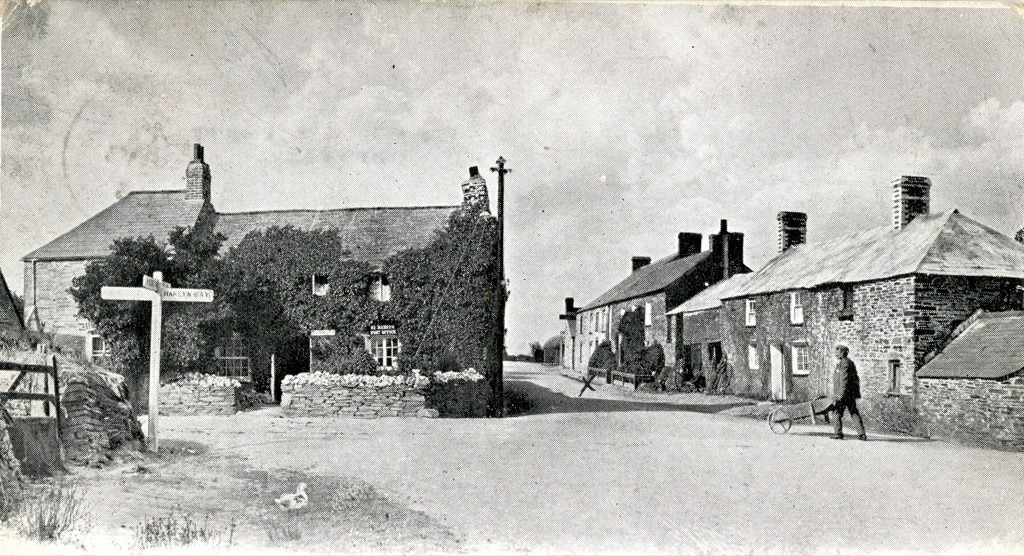
In Victorian times the place was a lot more alive than the photo below might suggest. Almost half of its men then worked as farm labourers with another quarter being farmers or farmers’ sons. The rest shared a variety of occupations, often combining them with farming and apparently ready to switch jobs in the light of changing economic circumstances.
John Old was one. He was a farmer in the parish in 1851 but gave that up during the 1850s to become a shoemaker and sub-postmaster. His son Joseph, born late in 1850, had a spell as a farm servant in St Columb Major before turning to the carpentry trade and moving back to St Merryn. Joseph then combined carpentry with being landlord of the Cornish Arms at the churchtown, no doubt aided by his wife Mary, a Devon girl he had married in 1879. Then, in a mirror image of his father’s move from farming to multiple occupations, Joseph gave up the pub and, one assumes, the hammers and chisels, saws, bradawls and planes of his trade and rented a farm in St Minver parish across the Camel estuary. It was there that he ended his days in 1904.
Mary Brenton was another St Merryn child who ended up on a farm, in her case despite being brought up in a craftsman’s household. Her father was a stonemason in the parish in the 1850s. Mary undertook the normal spell as a domestic servant in her late teens and twenties, as a cook in the household of the Vicar of nearby St Eval. She then married Thomas Henry Old, recorded as born in St Merryn and very possibly related in some convoluted way to the Old family discussed above. Thomas Henry was a farm labourer and he and Mary spent time in St Ervan and St Austell from the 1870s to the 1890s. At the relatively advanced age of mid-50s, Thomas was finally able to take up a farm at Trerair in St Eval, where he and Mary lived in 1901 with one of their daughters.

 Cornish studies resources
These parishes are still replete with Olds and Brentons. But curiously I don’t recognise ‘Trenade’ Farm in this parish (St Eval) nor can I find TH Old in the 1901 census. Can you help me?
LikeLike
That’s because it was Trerair and not Trenade – the original census transcription was wrong. I’ve added a screenshot of the 1901 census entry for Henry and Mary.
LikeLike
Thanks, that makes complete sense.
LikeLike
I am interested in a part of St. Merryn History that relates to a woman named Catharine Amy Dawson Scott (1865-1934). She had cottages, she would let them out to a variety of writers, in and around the area from at least 1910 prob. earlier) to her death in 1934. Her son stayed in the area and I do know that one plot of land that she must have had has now become a new build called “Ursula’s Cottage”. I am visiting the area on the 27th of March to follow her history. She owned at any one time Levorna (Levorna?)cottage, The Holt, people say Waste Hills (but I am not so sure although she did write a book called Wastralls). There are others that she owned and let out to writers, Dorothy Richardson, Noel Coward, J. D. Beresford and others. She also wrote Nooks and Corners of Cornwall. If there is any information you may know of to help me follow her path then please let me know.
LikeLike
I’m afraid I don’t know of any specific information on her link with St Merryn. Perhaps a local historian of the area might exist who can help you. I do know she was the cousin of the Cornish author Henry Dawson Lowry who wrote some excellent and evocative short stories set in the west Cornwall of the 1890s. She co-wrote and completed Lowry’s unfinished novel Wheal Darkness – he died quite young in 1906.
LikeLike
Hello Bridget,
Only just noticed your note from last week. ‘J D Beresford’ caught my eye. I thought he had been a publisher but remembered that he rented a nearby house to D H Lawrence for –
I believe – six months or so. That stay convinced Lawrence he should stay in Cornwall, but a writer friend who D H lured down was not so charmed and fled back to London. Can’t remember who that was. It is in St Merryn parish, but not in the (now vasty overgrown) village. see https://www.greatbritishlife.co.uk/news/22627071.rescued-restored/
I haven’t seen inside the ‘restoration’, which like the Victorian church scraping usually devastating.
I live a mile or so away. The pub, a converted summer retreat for a Home Counties canon built in 1930, developed into a slightly sordid roadhouse, was nevertheless our local for many years. Now closed for redevelopment, probably aiming for a large block of holiday lets.
Lawrence wrote about his time in West Cornwall, near Zennor, in ‘Kangaroo’, a strange novel of Cornish and Australian mysticism.
LikeLike
I’ve just written a lengthy response before being asked to log in. I hope it will get through to Bridget. It concerns D H Lawrence renting Porthcothan House from J D Beresford (who I thought was his publisher). This would be about 1915, and he and Frieda went on to West Penwith, where they were mistaken for German spies (see hos novel ‘Kangaroo’).
https://www.greatbritishlife.co.uk/news/22627071.rescued-restored/
LikeLike