Sometimes in the past relationships broke down, as we saw in the case of Jenny Moore from Calstock. Sometimes, no doubt, the laconic entries of census enumerators and registrars may hide family quarrels underlying the departure of a family member. Yet, at other times, those same records can hint at a high level of support from family in the nineteenth century.
Take for example Mary Rogers, born in Camborne around 1850 to a young couple, iron moulder James and his wife Eliza. At some point between 1853 and 1858, the family moved to Plymouth, where James continued his work as an iron moulder. In 1871 Mary was a domestic servant recorded as staying with her married older sister Eliza and Eliza’s husband Henry Wragg.
Henry was a sailmaker originally from Liverpool. In the 1870s he and Eliza moved back north but to Yorkshire on the other side of the Pennines. Mary Rogers looks to have accompanied them as she married an Edward Metcalfe from Bedale in north Yorkshire in the Dewsbury Registration District in 1879.
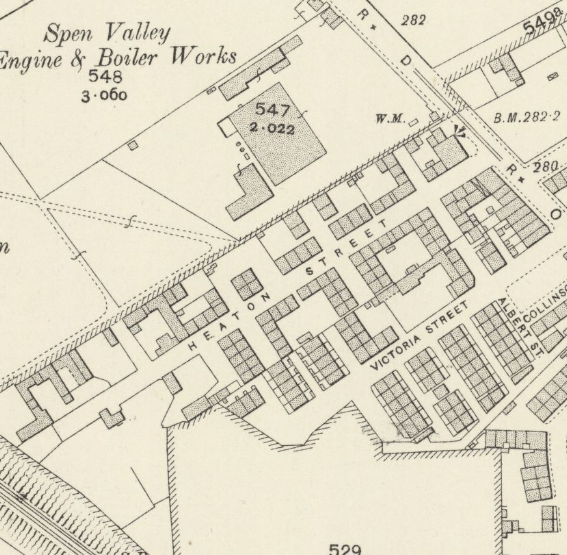
In the 1881 census we find Mary and Edward living in Heaton Street in Cleckheaton, south of Bradford. Henry and Eliza Wragg and their family were living in the same street. Ten years later Edward and Mary were living next door to Mary’s sister Eliza, now widowed, and her family while their 67 year old mother Eliza Rogers was also in Eliza’s household. By 1901 Mary’s sister and mother were no longer in the street, but her younger brother Francis was now renting the house next door.
These bare locational details must disguise a depth of family mutual aid in conditions near to the poverty line. Edward’s income as a cart driver must have been precarious and he and Mary were living in an overcrowded two-roomed cottage in 1891, shared with Edwards’s two grown up sons from a previous marriage, an infant child and a niece of Edward.
 Cornish studies resources
I often wonder how these families travelled North at that time? Any transport must have been expensive. My g g grandfather moved from Ludgvan to Cleveland in N Yorks to work in the ironstone mines. How did they travel? Incidentally, none of the Yorkshire enumerators could spell Ludgvan and there were some fantastical spellings.
LikeLike
It’s a good question and I’ve seen very little written about it. After the 1870s cheaper train travel would have solved the problem but the railways were relatively expensive from their early days in the 1840s to the 1870s (and of course before 1859 there was no direct rail link from Cornwall to the north of England). Before then the options for the poor would have been limited to stage wagons or walking or, if possible, travel by sea.
LikeLike
I’m sure I’ve read that the new mines in Cleveland posted adverts in papers and/or on posters to attract skilled miners to their newly opened mines. Looking at the records from those mines and census returns, there were quite a few Cornish miners and families took the trip. I’ve wondered if maybe seas transport was laid on for them, or even if they could have travelled with the herring fleet which went around to the Yorkshire coast.
Incidentally, my Cornish mining family married into a Staithes fishing family who had bought a yawl from St Ives.
LikeLike
I realise this is an old post but just come across it. I would love to know why Cleckheaton in particular. The mills would have provided employment but it was such a long way to go! Mary was my g g grandmother and the family stayed in Cleckheaton until my dad’s generation and are still in the area now.
LikeLike
Perhaps one of the local mills was advertising for labour or a neighbour/family member/friend had already moved to Cleckheaton. Mary and her sister and brother in law must have felt that there more prospects in Yorkshire than in Plymouth, although they don’t appear to have particularly prospered from the move.
LikeLike