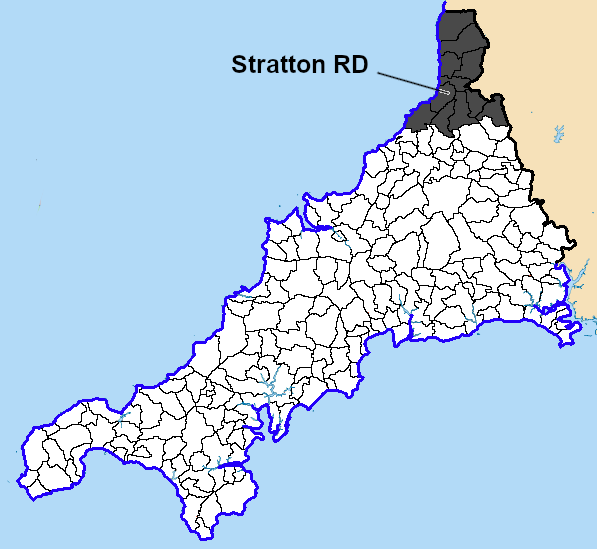
Stratton Registration District (RD) in the far north of Cornwall was the smallest in 19th century Cornwall in terms of population. This was because it had one of the lowest population densities of the 13 Cornish RDs. Yet, the proportion of the Cornish Lives sample born in this primarily rural and agricultural RD was probably the highest in Cornwall. An extremely high 94 per cent of the boys were found as were 86 per cent of the girls, much higher than the Cornish average of around 78 per cent for both genders.
Although the absolute number is still too low to draw any hard and fast conclusions, we mustn’t imagine that this was an essentially immobile group of Cornishmen and women untypically rooted to their native hearth. The numbers going overseas look to be around the average for Cornwall. In fact, the far north had been one of the first sources of mass migration to North America in the 1830s. This tradition clearly still resonated with the generation growing up in the 1850s, with Canada their principal destination. While seven of the 42 surviving boys were living in North America and three of the 40 girls, only one boy and two girls could be found in the southern hemisphere in 1891.
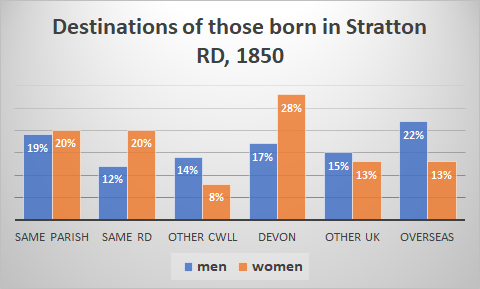
Meanwhile, anyone still subscribing to the old myth that our ancestors lived out their lives and died in the parish of their birth needs to think again. Only one in eight of the boys who had survived into the 1880s were living in the parish of their birth. That proportion was rather higher for girls, being one in five. Overall however, well over half of the children born in 1850 (around 70 per cent of the boys and 60 per cent of the girls) had left the Stratton RD for other places. Girls were significantly more likely than boys to have moved across the nearby border and into Devon.
 Cornish studies resources