As members of homo sapiens (purportedly), we like to impose patterns on the world around us. Often, however, the information available mean that those patterns exist in our minds rather than in the world around us. So it could be with the pattern of migration from the Camelford Registration District (RD) in the later nineteenth century.
The fundamental reason that drawing a pattern from these data might be unwise is that the number in the Victorian Lives sample born in this RD turn out to be too low for comfort. In fact, they are considerably lower than the numbers from neighbouring Stratton RD, especially for boys. For what they’re worth, the locations of those born in Camelford RD and surviving into their 30s is shown in the two pie charts below.

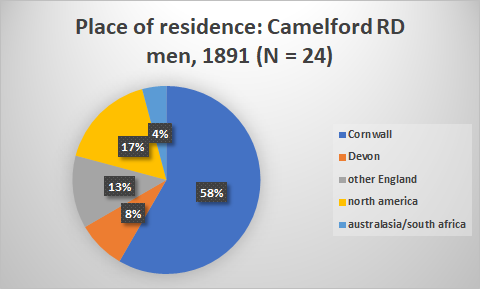
As it happens, the picture is not that different from Stratton RD. The proportion going overseas is very similar, suggesting the same migration culture was found throughout Cornwall’s north coast parishes. Interestingly, the four boys who went to North America were all found in Canada, as was the pattern further north in Stratton. But the four girls were all in the US. Three of those girls hailed from St Teath parish, where the slate quarries had strong links with quarries in Pennsylvania. This strongly suggests contrasting migration details between farming and quarrying parishes.
Camelford boys were somewhat more likely to be still found in the RD itself, while both boys and girls were less likely than their Stratton counterparts to have departed for Devon. This is hardly earth- shattering news as the RD had no border with that county.

 Cornish studies resources
Dear Bernard
i still cannot log in properly from my computer (I can send comments from my mobile but that is more work!)
I made this comment to your really good article today.
Cathy
Nice opening comment.
What is interesting to me is that women and men seem to draw on very different informational and probably support networks when thinking of migration. It is fascinating that women in this case migrated to the US whereas men went to Canada. Presumably in Camelford both genders had info about both options but men decided to realise one, and women another.
It would be interesting to establish the actual driving forces behind these patterns.
LikeLike
I wouldn’t draw too many conclusions from Camelford because of the very small numbers involved. At present I’m thinking occupational background is explaining as much as gender, or pehaps more, when making emigration decisions. But it should become clearer as I complete the analysis.
Incidentally, I have no idea why you’re having trouble logging in. No-one else has raised this.
LikeLike