Back in 1961 Cornwall and Scilly were home to around 340,000 people. The population then began to rise sharply. By the end of this century on current trends it will be knocking on the door of a million, or 990,000 to be exact. While that’s likely to be the least of our worries if ‘business as usual’ blindly continues, the recent population history of Cornwall shows little sign of any imminent slowdown of the steady urbanisation of Cornwall and the associated erosion of its countryside.

Over the 2010s the rate of population increase began to creep up again, after two decades of rather slower growth. As the population rises of course, percentage growth rates translate into ever larger absolute numbers. Over the last decade almost the equivalent of Camborne-Redruth or, if you prefer, four Truros, have been added to Cornwall’s population numbers. Even if the growth rates don’t rise further, this level of growth is set to continue.

If we put this in context we find that in Cornwall the population has risen much faster than in the other nations of Great Britain over the past half-century. Since the 1970s this has been entirely fuelled by net migration – the excess of in-migrants over out-migrants. Left to its own devices, the Cornish population would be slowly shrinking.
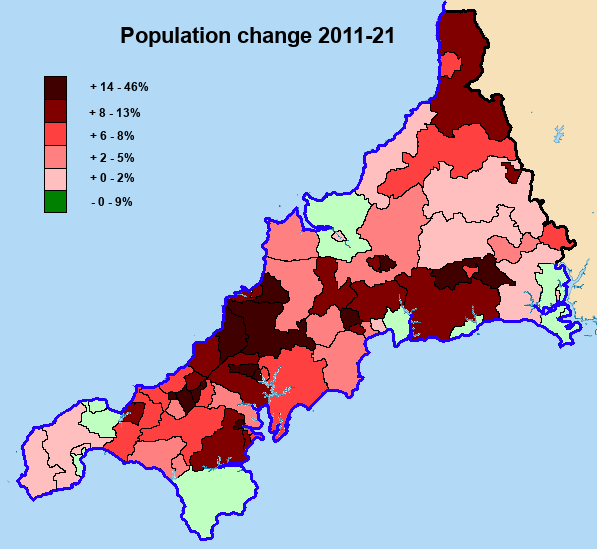
Within Cornwall recent growth rates vary greatly. The highest rates since 2011 have been experienced in or near the main towns and the coast near Newquay and Perranporth. Nevertheless, some districts have seen population falls. Most have been tourist spots, hollowed out by second homes and holiday lets, places such as St Ives, Newlyn and Mousehole, the Camel estuary, Fowey and Looe. The interesting exception is Saltash which, despite its proximity to Plymouth, has not (yet) taken its share of the swelling numbers.
 Cornish studies resources