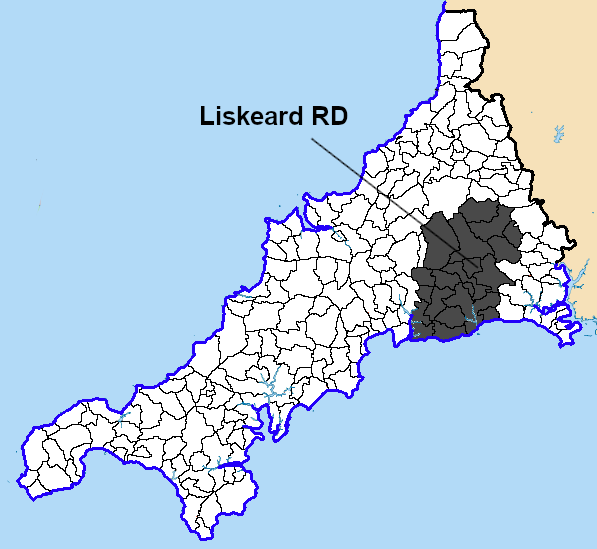
Let’s return to the Cornish Victorian Lives database. Liskeard Registration District (RD) was large in terms of area and, relative to the other eastern RDs, population. Like the Calstock/Callington sub-district that was reviewed in the previous post and unlike the RDs to its north and east, it had been more than touched by mining operations. In Liskeard’s case this had been a recent phenomenon, a mining boom getting under way in the 1830s but cut short in little more than a generation.
Given its occupational structure, it’s no surprise that the migration history of those of our cohort in this mixed mining and farming district was very similar to that of the Calstock area. Around a fifth of the boys traced had emigrated by the 1880s, three quarters of them to North America. A considerable number of men had also left for northern England. An unknown number of those will in time have used a spell in the iron mines of Cumbria or coal mines of the north east as a stepping stone to another destination overseas.
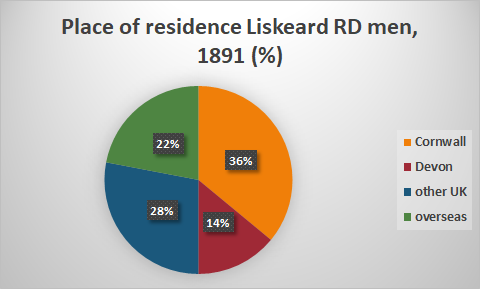

Gender differences were profound in this RD. Almost two thirds of girls born in the Liskeard RD were still found in Cornwall in the 1880s, in contrast to only just over a third of the boys. The proportion of female emigrants was – at less than 10% – very low, lower in fact than from the purely agricultural districts of north Cornwall. Meanwhile, girls were much less likely than boys to have travelled further afield within the British Isles.
The numbers born in the Liskeard RD were far higher than in the RDs already covered, which allows for greater confidence in the results. However, the proportion traced was also significantly lower, at 71% for both sexes. This might imply that the numbers migrating and thus more likely to have been untraced were higher than the data suggest.
 Cornish studies resources