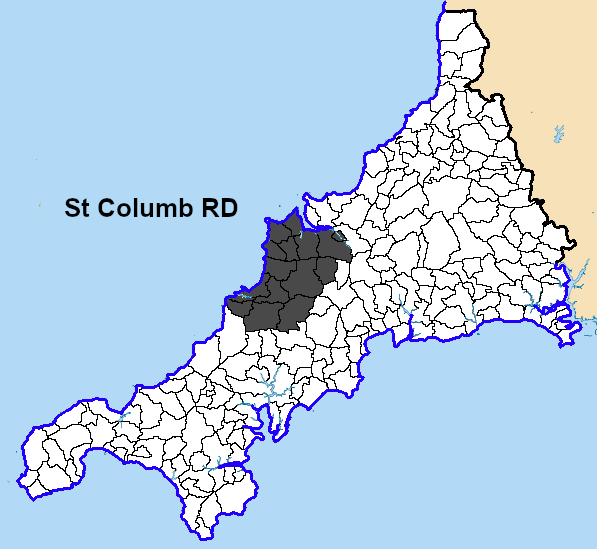
Children born in the St Columb Registration District (RD) around 1850 grew up at a time when Newquay was a small fishing and trading village. Newquay’s population was still under 3,000 as late as 1901. It then grew rapidly in the first half of the twentieth century to overshadow the market town of St Columb and become the main settlement in the RD. By the early 1960s the number of permanent residents had reached 12,000. It’s now home to over 20,000 people and one of Cornwall’s major urban centres, with numbers estimated to soar to as many as 75,000 to 100,000 in summer. Meanwhile, the urban area steadily devours acres of open countryside to its east.


In contrast, St Columb RD turns out to be – in demographic terms at least – fairly unremarkable in the third quarter of the nineteenth century. In the previous post on the quantitative evidence of the Victorian Lives database we saw that in Bodmin RD there was little difference between the sexes. In neighbouring St Columb RD there was a marked difference. The number of boys who were untraced was somewhat higher than the average for Cornwall while the 90% of girls traced was the highest proportion so far.

This might imply that more boys migrated than the raw data suggest. With a higher proportion in the RD engaged in mining when compared with neighbouring Bodmin RD, the greater number leaving for other places in the UK or overseas might come as no surprise.

Girls were more likely to remain in the RD with the proportion still living in Cornwall in the 1880s only surpassed by Launceston among the RDs previously examined. Despite that, the proportion of girls migrating was not that much lower than boys and similar to the proportions seen in the northern RDs of Stratton and Camelford.
 Cornish studies resources
