Hosking and its variants is a surname that, more than most, seems to trigger disagreement over its origins. The consensus among the surname experts is that Hosking and its various spelling variants emerged from Middle English Osekin. The theory is that it was a pet form of first names beginning Os-, such as Osborne, Osmond or Opie (a pet form of Osbert). These had -kin added to them, as had names such as Jenkin or Tonkin, a development that appears to be especially prevalent in Cornwall.
However, there is a possibility, given the pattern of the name in the early period, that at least some Hoskings could well have originated in the placename Heskyn (meaning sedge or coarse land) at St Germans. There is one example of that place being spelt Hoskyn in 1314, although other spellings of this surname element are invariably hesk-, while in Welsh and Breton it’s also hesk-.
Spelt Hoskyn in the early 1500s, the spelling of this surname had shifted by the nineteenth century to the modern Hosking, as this table shows:
| 1530s | 1641 | 1750s | 1861 | 1950s | |
| Hoskyn | 99 | 16 | 13 | 0 | 0 |
| Hosken | 1 | 12 | 21 | 9 | 16 |
| Hoskin | 0 | 55 | 41 | 27 | 29 |
| Hosking | 0 | 17 | 24 | 63 | 55 |
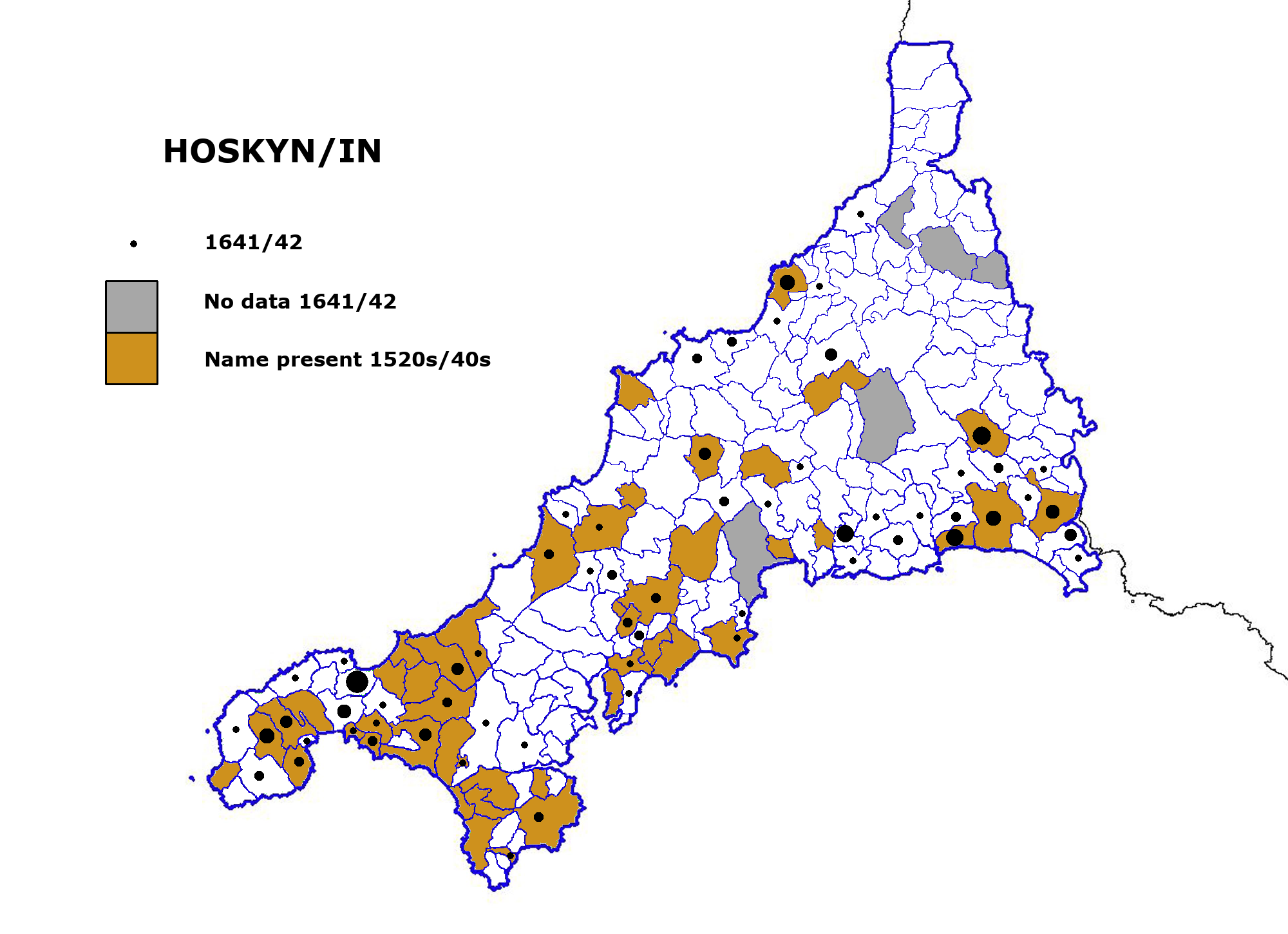
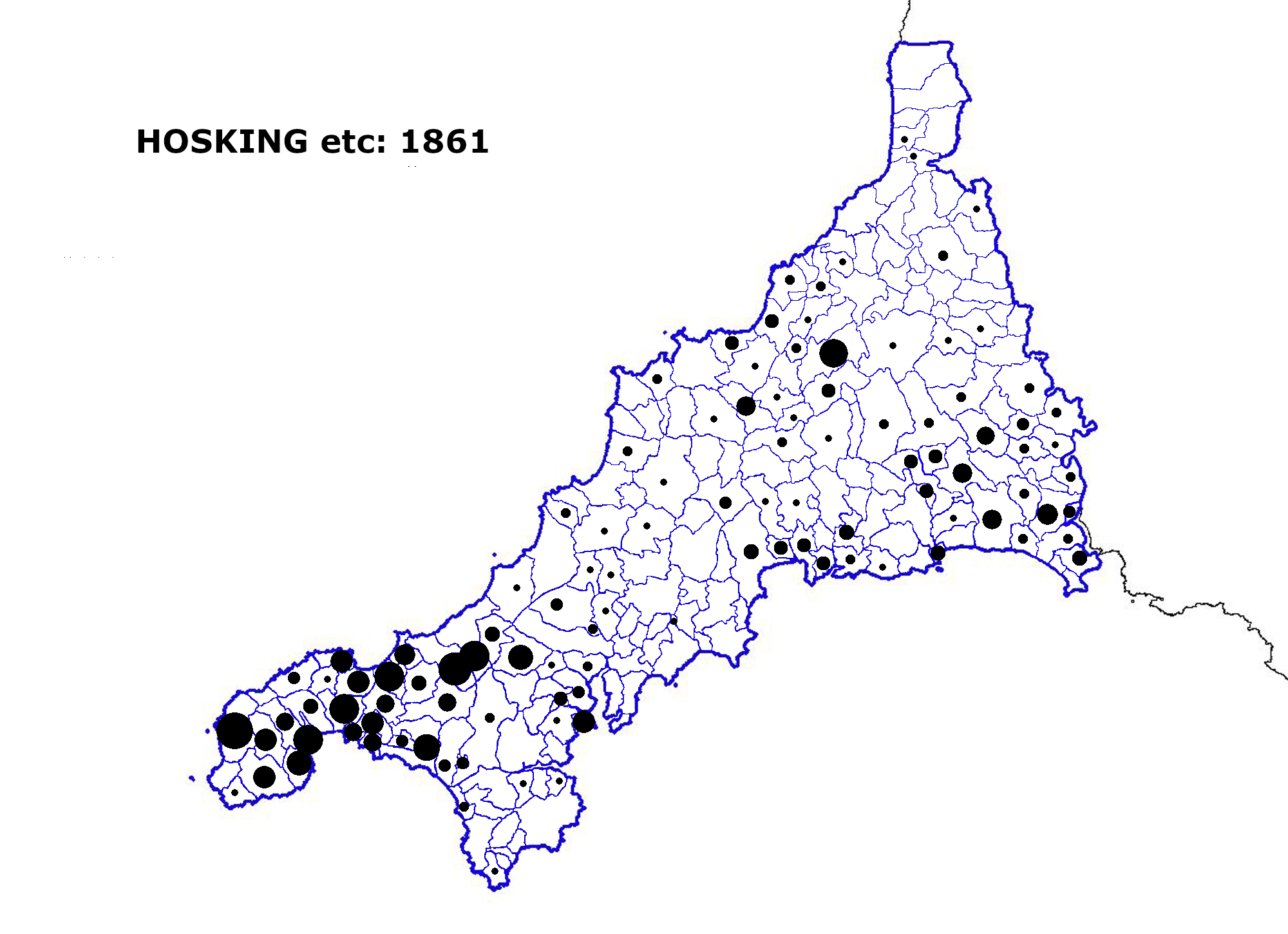
In the 16th and 17th centuries the name Hoskin was mainly found in west and south-east Cornwall, while being rare in north Cornwall and large parts of mid-Cornwall. In 1861 this geography was still visible, but with a definite concentration among the western group on West Penwith and the Central Mining District.
Postscript: an update on the new edition of The Surnames of Cornwall will be posted here later today.
 Cornish studies resources
This site is a really interesting and useful resource. I assume that researching origins of Cornish names is particularly difficult due to the language not being English. I am not sure when common family names started in Britain but I believe that pretty much all of Cornwall (and some of Devon) spoke and lived in the Cornish / Brythonic language up until the late 1600s, and most of West Cornwall continued this for another century. Presumably many family names would have arisen from a completely different structure of language and ways of allocating names to people and things, than that of olde English. I wonder if the research is necessarily predicated on English norms (like ‘kin’ and ‘son’ and ‘er’) rather than any Brythonic ones that may be known (e.g. using Welsh genealogy techniques, if any exist). In the case of Hosking (which is my name hence the interest), if it is a trade name, we should be aware of the fact that Brythonic languages do not suffix trade names with anything. To use Welsh as an example, an undertaker was colloquially known as the ‘death’ and a railway stoker as the ‘coal’ or the ‘steam’. It is likely that Cornish would have been the same, but then that would be guess work as much of the original language basis is lost.
I am keen to find out more about my ancestors culture and language and I will be using this site more often going forward now that I am retiring from my day job. Many thanks. Mike Hosking.
LikeLike