The distribution of the 578 households in Cornwall headed by someone called Bennetts or similar in 1861 would strongly suggest that the surname arose in west Cornwall.

However, that would be a mistake. If we turn to a map of the name Bennet in the early 1500s and 1641 a very different picture emerges. In Camborne for example, the epicentre of Bennetts in 1861, there was no Bennet presence in the 1500s.
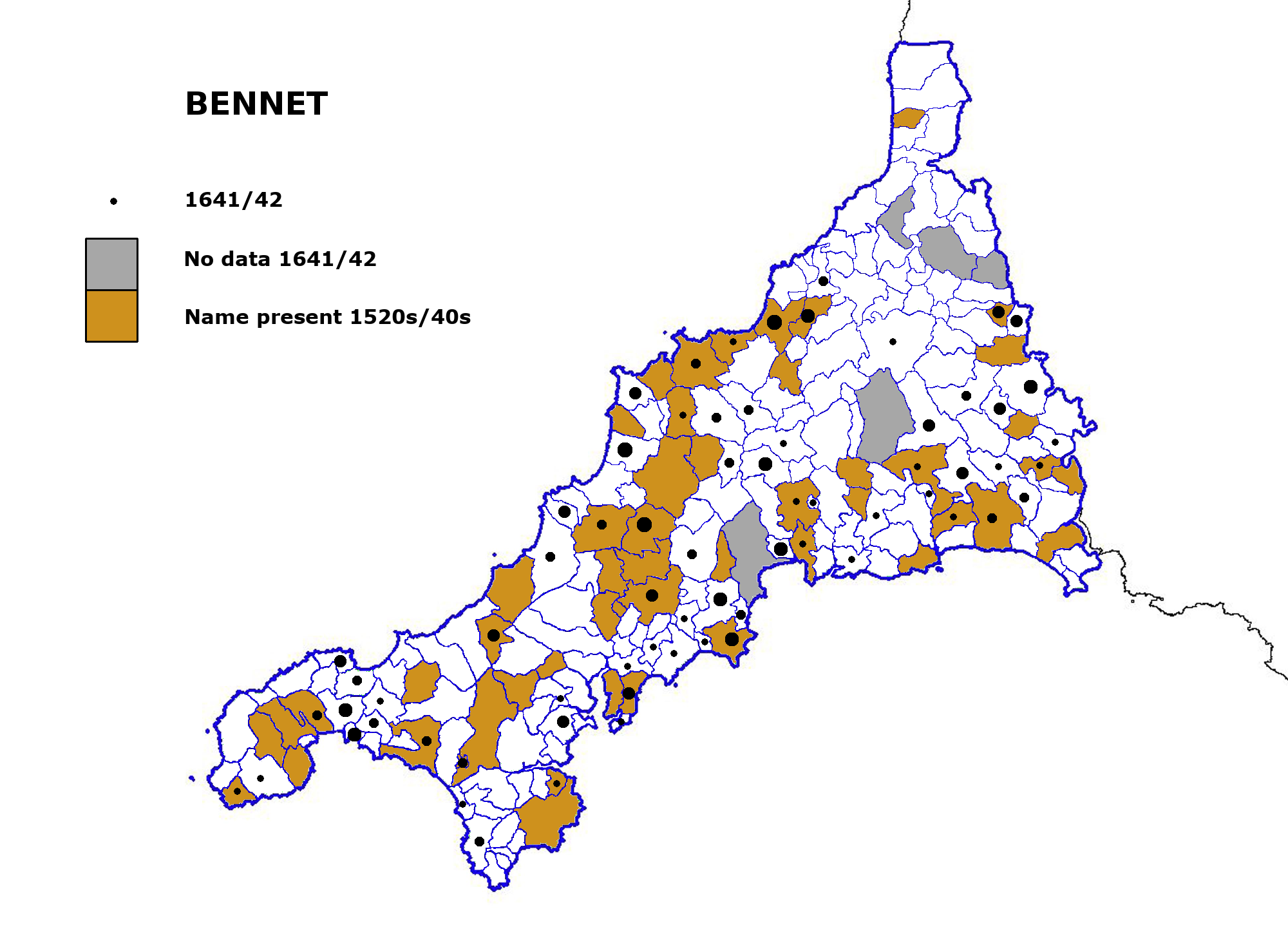
The Latin Benedictus (meaning blessed) had produced the Old French and Middle English Beneit or Beneoit, which was used as a first name for both men and women from the 1100s to the 1300s. Its pattern in Cornwall implies that it was found across the land, in English-speaking as well as Cornish-speaking parts, with the only exception being the more sparsely populated north.
Yet, over the following 200 years it came to focus strongly on the west. This tells us more about the economic history of Cornwall than it does about this surname. Bennetts were attracted to the industrialising mining parishes of the west and once there the surname ramified. During their sojourn to the west Bennet tended to gain an <s>, but much more slowly than in the case of some other surnames. Bennett or Bennet still enjoyed a marginal advantage over Bennetts in 1861.
 Cornish studies resources
Yes, but what about Bennetto? When and where did that variant arise? It’s not a name I’ve ever heard outside Cornwall.
LikeLike
Bennetto was a Cornish language variant that emerged in West Penwith in the late 1400s and early 1500s. It died out there as the language retreated but held on in mid-Cornwall, where similar names – e.g. Daddow, Higow, Sandow – survived rather better, this probably being a reflection of differences in the timing of byname becoming surname.
LikeLike
thanks for this, Bernard! Bennetts is the first of my Cornish ancestral names to appear on your list. Anticipating Johns and, especially, Harvey, with bated breath. Cheers Cheryl Hayden
LikeLike
You didn’t have to wait long for Johns!
LikeLike
I’m a Bennetts descendant. Just started to research – a bit. So this was fascinating. And I can absolutely corroborate the mining connection – Capt James Bennetts of N Levant ( later Geevor ) was my gt gt grandfather. So any connected Bennett’s please get in touch. He had three sons and a daughter. I believe all the sons went overseas. But the daughter is my gt grandmother and I have a Victorian Bennett’s bible – in case anyone is interested !
LikeLike
I’m not a Bennett descendent, but my great-grandmother was a seamstress/mender/laundress for the Bennett estate. As my grandfather remembered, they lived on the edge of the Bennett estate and he had fond memories of the kindness and generosity the Bennetts showed to his mom, a widowed mother of three small children. Her name was Annie Holman, nee Carlyon. She was widowed about 1898 when my grandfather was 3-years old. His father died of black lung disease acquired in the copper mines of Cornwall, and a couple of years in the diamond mines of Africa.
LikeLike
I am a Bennetts. My father David Roger Bennetts born 16.2.1934 in London.
His father Roger Andrew Bennetts born 15.2. 1898 approx. Born in Cornwall. Former Royal Horse Artillery in Burma. Also Foreman smelterer in a local tin mining Co. in Burma. Married Oda Marie Nee Andersen of Denmark. Known relation in London Edgar Bennetts (lost touch)
We are Bennetts not Bennett😊 We are under the impression from my Grannie Oda that the Bennetts family didn’t approve the Danish connection. So have lost contact with any Bennetts. My Dad is 91 now & would like to hear from any that would know of this line of the Bennetts.
LikeLike
This recipe looks EXACTLY like my Cornish grandfather’s way to make them. And he would add one more rule – NEVER use gravy on a pasty!!! Ketchup was acceptable.
Can’t wait to try this soon!
LikeLike