Ella Westland, ‘Rule Brittania, Brexit and Cornish identity’, LISA e-journal 19.52 (2021)
As a child Daphne du Maurier spent her summers at the family’s second home in Fowey. She then lived permanently in Cornwall from 1943 until her death in 1989. Best known for her Gothic novel Jamaica Inn (1936), together with Frenchman’s Creek (1941) and Rebecca (1938), du Maurier made her reputation by helping to embed Cornwall’s already hardly inconsiderable romantic associations. She wholeheartedly adopted Cornwall but did Cornwall adopt her?
In this article (available free online at https://journals.openedition.org/lisa/13794) Ella Westland focuses on du Maurier’s last novel – Rule Brittania, published in 1972. Of her novels, this was the least well received by the critics, who almost unanimously dismissed it as her worst. It was very different from her previous books, a comic novel set not in the past but in an imagined near future.
With uncanny prescience du Maurier had imagined a situation where the UK holds a referendum resulting in its departure from the Common Market as it was then known. This results in economic turmoil which brings the USA riding to the rescue as British politicians agree to be part of a united USUK. But Britain’s intended role as an off-shore theme park is disrupted by a plucky band of Cornish locals led by a feisty 79 year old incomer appropriately named Mad (from madam). Obtaining a supply of gelignite from the clay works and in league with shadowy ‘Celtic nationalists’, the resistance succeeds in destroying an American warship and the novel finishes with the future of the USUK project once again up for debate as politicians begin to have second thoughts with opposition mounting.
Ella Westland argues here that her final novel marked a change in du Maurier’s relationship with Cornwall. The deep love of the landscape that informed her earlier work had been joined by respect for its people. Rule Brittania was the culmination of this while also being a product of Daphne’s personal experiences of the time and the prevailing political environment. The latter involved Britain’s entry into the Common Market in 1971 and the rise of Celtic nationalism in the late 1960s.
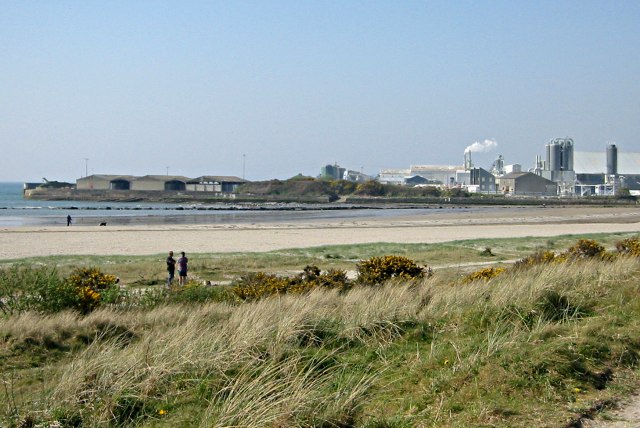
The 1960s were not happy times for du Maurier. Her husband died in 1965 and the end of the lease of Menabilly, the house where she had lived for a quarter of a century, meant she had to move to Kilmarth, above the small former fishing port of Polkerris. From the top of the hill behind Kilmarth it’s possible to look over Par Beach and see the tall chimneys of the clay dries at Par Harbour. Ella Westland suggests that the visible presence of the clay industry forced itself into du Maurier’s consciousness after her move.
Du Maurier’s initial connections in Cornwall were mainly restricted to the landed class and liberal intellectuals such as Q (Sir Arthur Quiller-Couch). Du Maurier’s contacts with more ordinary Cornish people was through tradesmen and servants and the Cornish in her novels tended to be sturdy stereotypes – farmers, fishermen and boat-builders. However, Ella Westland insists that she came to ‘detest patronising attitudes’ to the Cornish and identity herself with us. This was seen in her dalliance with Mebyon Kernow in 1967 and the publication of Vanishing Cornwall in the same year.
Nonetheless, her letters suggest that du Maurier saw joining MK as a bit of a romantic jape rather than something serious. Wild remarks about blowing up the bridge, speaking Cornish and wearing kilts illustrate a certain lack of familiarity with the extremely mild and boringly sensible policies of the MK of the time. Moreover, in Rule Brittania the Cornish characters remain ‘affectionate caricatures’ – dependable, practical, brave and loyal. Their implicit desire is just to be left undisturbed rather than create a free and autonomous Cornwall.
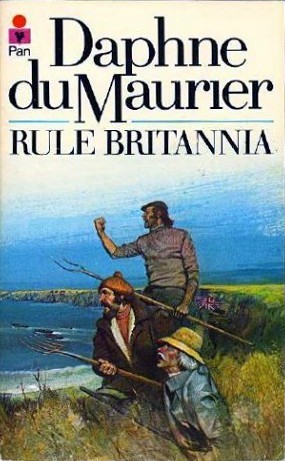
Significantly, the central character in the novel is the incomer Mad, in league with the locals. Ella Westland convincingly argues this is a clear ‘batty incarnation of Daphne herself’. Or what she might have liked to have been seen as – the incomer respected and accepted by the locals, one who shared her own detestation of the commodification that she believed was ruining her beloved landscapes.
Ella Westland claims that in her final work du Maurier found inspiration to ‘harness the Cornish spirit of self-reliance, their determination to pull though and resist oppression’. Maybe so. It certainly doesn’t take a genius to guess what she might have made of the palpable lack of spirit evident nowadays in the face of the commodification ravaging Cornwall at levels she could only have dreamt of. She would no doubt have had some choice words for the current local ‘leaders’ whose vision extends no further than bigger roads, lots of tourists, more housing to attract ever more people and the insane pursuit of unending ‘growth’ at all costs.
 Cornish studies resources
