Constantine Manolchev, ‘’Dances with daffodils’: Life as a flower-picker in west England’, Work, Employment and Society 36 (2), 2022, pp. 372-380
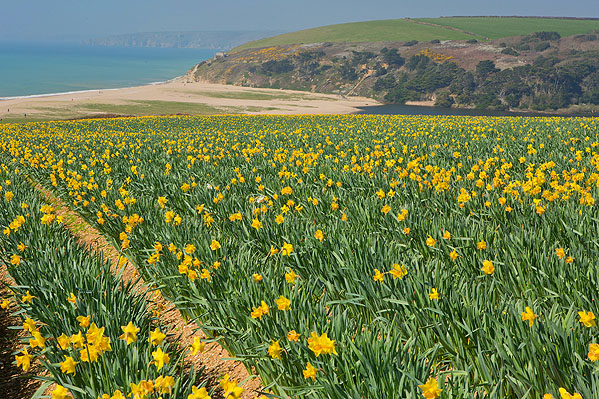
Daffodils don’t just give rise to flowery poetry; they’re big business in Cornwall. An estimated 30 million tonnes of the flowers are picked, packed and purchased each year. But how much thought do those buying the neatly packaged bunches of daffodils give to the hidden sphere of production that lies behind these golden blooms?
Getting the daffodil to the vase involves some workers spending eight to twelve hours a day out in all weathers during the picking season. Good money can be earned by piecework if you’re young and fit. But the repetitive bending over and picking at speed can be hell on your wrists and backs. Most of us wouldn’t last for more than a few days at the task, which is part of the reason that the labour demands of the daffodil farms are met by seasonal labour, most originating in eastern Europe and, since Brexit, further afield.
This short article shines a valuable light on the lives of the daffodil pickers via a narrative provided in 2020 by Ivan (a pseudonym) who had worked on a 600-acre Cornish daffodil farm for over ten years. Constantine Manolchev introduces Ivan’s tale by noting how the agri-food sector more generally has seen a rise since the 1980s in precarious work (or precarity), such as zero-hours contracts or questionable self-employment. This is placed in the context of Thompson’s model of disconnected capitalism, which observes how increasing expectations placed on workers through commodification and new IT-based control mechanisms have combined with decreased job-security and opportunities. Nevertheless, workers’ experiences are not uniform as even in an age of rampant neoliberalism some can experience a sense of job satisfaction as subordination co-exists with degrees of worker agency.
This paradox is then illustrated through Ivan’s narrative. With a degree in economics from a Bulgarian university and able to speak five languages, three of them fluently, Ivan first came to Cornwall on a seasonal work permit in 2008. He was directed to work on the daffodil farm and was able to survive and even prosper as a picker. He returned for three seasons before becoming a team leader, responsible for planning the work of a gang of up to 60 people. Given the pressures of piecework, this was no easy task. For example, deciding on the position to place the trailers which collected the trays of picked daffodils was critical. The wrong choice could cost the pickers valuable time in walking to them, leading to dissatisfaction and resentment.
Moreover, the bunches of daffodils, usually of ten stems, would suddenly have to be re-bunched when one of the big four supermarkets who bought them decided to change the number of stems in each bunch. According to this article that might happen on a weekly basis. Re-bunching flowers already picked costs time and money.
By 2013 Ivan had been promoted again to become a welfare manager, looking after the 500 migrant pickers on all the farm’s sites. Greater responsibility provided greater job satisfaction. However, Ivan reported that, on site seven days a week, ‘there is little else in my life outside of work’. Despite good pay and greater status, at the time he wrote his narrative Ivan was feeling a sense of frustration as his employers were refusing to confirm him as payroll manager, a job he’d been covering temporarily and one where he could better use the skills gained on his degree course.
Even Ivan, who had moved to the management side, encouraging production and monitoring productivity, was coping with precarity, as were the daffodil pickers, under pressure to pick their quota of blooms. The insights in this article might trigger some wider questions however. Just how sustainable or necessary is an industry such as daffodil production? The carbon footprint alone of the migrant labour travelling to and from Cornwall and the transport of the daffodils must be considerable. Is it worth it?
 Cornish studies resources