In May of 1591 deaths began to spiral at Redruth. That year saw burial numbers in the parish registers hit a figure nine times higher than the usual. Yet by Christmas the crisis was over and burials had reverted to their normal level.

Sudden short mortality crises like that at Redruth suggest an airborne infection, such as the ‘sweating sickness’ of the early 1500s. Pneumonic plague is another possibility, although plague mortality usually occurred slightly later, peaking from July to September. A third possibility is famine or poor nutrition caused by food shortages. Although burials in Redruth in 1591 were consistently higher than normal all year, there was no sign of the mortality peak of early spring that might be expected if famine were the cause.
Plague was reported in the period 1589-93, spreading out from Plymouth. Many decades ago Norman Pounds identified mortality crises in Morval, St Neot and St Columb Minor. At St Columb it was particularly severe, with a pattern that closely mirrors the classic plague mortality. That said, there is no evidence of any similar mortality crises in these years in the registers of St Erth, Gwithian and Mawgan in Meneage in the west, or at St Breward in the east.
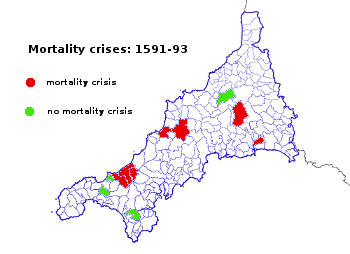
Redruth’s neighbour Illogan experienced a similar mortality crisis in 1591, but the worst months in Camborne occurred much later, in the early winter of 1593, when deaths rose to ten times the normal level. The localised nature of these mortality crises and their dispersed timing might raise some questions about the cause. Was it simply plague or were there additional or multiple causes?

A similar mortality crisis at Camborne beginning in August 1547 more neatly fits the bubonic plague pattern. This event, when deaths that year were again over ten times the norm, is intriguing as it occurred less than two years before the rising of 1549. Unfortunately, at this date there are very few parish registers available to see whether other Cornish parishes experienced a similar crisis at the same time.
The whole issue of mortality crises in Cornwall in the 1500s and 1600s requires more research, especially as no Cornish data were used in Wrigley and Schofield’s classic The Population History of England 1541-1871.
 Cornish studies resources
I’d also like to learn more about spikes in death rates in the 1800s. It is evident from gravestones in Warleggan – very poignant – that some families were totally – or almost totally – wiped out.
Not sure what the rising in 1549 was about. Was it limited to Camborne or not? If not, then it seems hard to trace a link to bubonic plague, but it was then it may be possible to raise a hypothesis eg of fear, discontent, hunger and other factors leading to rebellion. I believe no one then understood the cause of the bubonic plague and it may have been interpreted as witchcraft or some kind of divine punishment.
Would be useful to know more about how such events were understood.
Thanks for such an amazingly diverse series of posts!
LikeLike
Given the summer distributions are these perhaps water-borne disease outbreaks?
LikeLike
Bodmin, August 1577, had the same pattern. See https://www.wikitree.com/g2g/1544791/so-many-deaths-what-happened-in-bodmin-cornwall-in-1577
LikeLike
I’m currently transposing typed pages of records recently found in St Neot Church onto a searchable database. There are thousands of entries from 1549 to 1812. In 1591 there were 104 deaths! Plague I presume? Our vicar (here in S Neot) Richard Bennet was hanged in 1549 for his part in the Prayer Book Rebellion.
LikeLike
If the pattern is of a summer peak (like the Redruth bar chart above) then it’s almost certainly some kind of plague. Many yeasr ago Norman Pounds identified St Neot as one of the parishes suffering plague in this period so your data back that up nicely.
LikeLike