Married life can sometimes be difficult, in Victorian times as nowadays. In March 1869 Jenny Moore and Edward Bergner were married at St Philip’s Church, Dalston in London. Jenny was Cornish, born in 1850 at Gunnislake, next to the River Tamar, the daughter of a general merchant. But, on his death in the 1860s, his widow took her family to the train and decamped to Paddington where she let out lodgings.
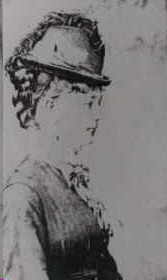
Edward Bergner was a merchant from Germany, whose father had been a colonel in the Prussian army. It was not long before things began to turn sour. According to the later claims made at the divorce court, ‘shortly after’ the marriage Edward began a regime of ‘great unkindness and cruelty’ towards Jenny, his ‘violent and offensive language’ and physical assaults ‘greatly’ impairing her health. In the spring of 1870, a year after the marriage, Edward had committed adultery, probably with a prostitute. He then ‘knowingly communicated’ the venereal disease he had contracted to his wife, who was well advanced in pregnancy, a child being born at the end of March, 1870.
Four months later, in July, Edward deserted his wife, who moved back in with her mother, taking her infant child Richard with her. There, she helped make ends meet by earning money from dressmaking.
After 1857 it had become possible to petition for civil divorce at the divorce court set up in London. Legal fees were still a cost too far for some and the playing field was hardly level. A man could petition for divorce if there was evidence of adultery on the part of his wife, but for a woman the adultery of her husband had to be combined with at least one of cruelty, incest, bigamy or bestiality on his part. Nonetheless, an average of 148 divorces a year were granted from the 1860s, rising to 600 by 1900. In a good proportion of these the petitioner was the wife.
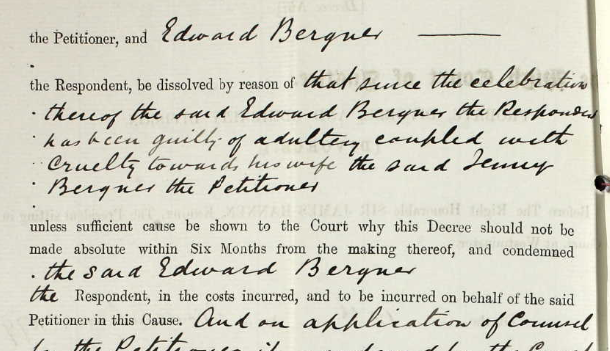
By 1879 Jenny had saved enough for the legal costs and took the step of petitioning for divorce on the grounds of adultery plus cruelty. The divorce was granted and it later emerged that Edward, by now a policeman in Bradford, had unwisely added bigamy to his sins by marrying again in 1878.
Once a civil divorce was granted legal re-marriage was possible, although it was a few years before Jenny stepped again into marriage by marrying Reginald Bishop, an auctioneer, in 1886. The pair were living, hopefully quietly, in Chelsea in 1891.
 Cornish studies resources
My great, great, great uncle John Cranch Walker Vivian, second son of General Sir Richard Hussey Vivian married for the second time in in 1861, Florence Rowley. They were divorced in 1869 after she eloped with the Marquis of Waterford, who she subsequently married. She died in childbirth. At the time of his divorce John was Liberal MP for Truro.
LikeLike