
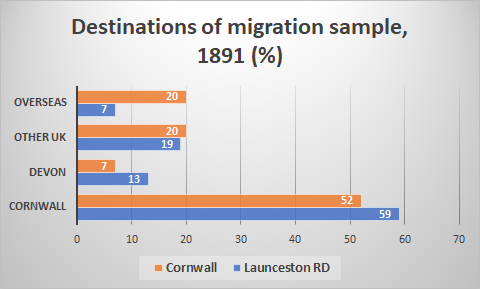
I have to admit to being somewhat perplexed by the migration pattern of the generation of 1850 in the Launceston Registration District (RD) as revealed in my Victorian lives project. In this largely agricultural and rural RD adjacent to the border with Devon one might expect more short-distance migration across that border and a lower than usual propensity to migrate overseas.
This is indeed what we find. Children born in the RD were more likely to be found in Devon in their middle age. Moreover, while they were about as likely as the general Cornish population to move to places in the UK beyond Devon, they were also more often still living in Cornwall. The difference is explained by the lack of emigrants; only seven per cent of Launceston children born in 1850 were overseas by the 1880s, starkly contrasting with the 20 per cent of children from across Cornwall as a whole.
What I find more difficult to explain is the gender pattern. In Launceston boys from the RD were more likely to move – both to Devon and elsewhere in the UK – than girls, while girls were twice as likely as boys to emigrate. The former might be explained by farm labourers making short moves across the Tamar to seek work on Devon’s farms, although it might be expected that the girls would be equally attracted to Plymouth, with its growing demand for domestic servants. As for the difference in emigration, I can only put that down to the low absolute numbers in my sample.
 Cornish studies resources

My daughter is studying for one semester in Tasmania. Close to Hobart is Launceston which I presume was founded by some of your Cirnish emigrants (?).
LikeLike
My family offers an example from this area: My GG-GF William Downing was born 1850 at Trewen. He and wife Maria (Hawke) had 15 children, and judging by their birthplaces, about 1885, the family moved south to the St. German’s area. My G-GF was the first to leave Cornwall, coming to the U.S. in 1906. Two more boys would join him in the U.S. Two boys would emigrate to Canada. One girl would emigrate to Australia with her husband. Another girl went to China with the missionary society, where she married, and eventually went to Australia with her husband. Another daughter crossed the Tamar, where her descendants still farm near Okehampton.
LikeLike