According to The Oxford Dictionary of Family Names, Stephen was the ‘partially vernacular’ medieval form of the biblical name Stephanus, which had its origin in turn in the Greek Staphanas. This first name had become popular as it was the name of the first Christian martyr, stoned to death in Jerusalem three years after the crucifixion of Christ.
The ‘fully vernacular’ form of the name was Steven, reflecting the pronunciation. However, the clergy and clerks making entries in parish registers and other official documents would more often than not prefer the more learned Stephen spelling. Nowadays, the view can occasionally be heard that Stevens is somehow more ‘Cornish’ than Stephens. How did this myth arise?
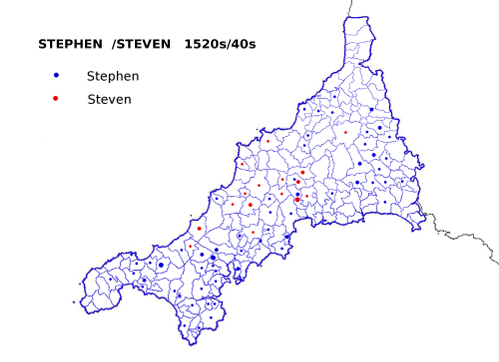
The surname Stephen or Steven was found across most of Cornwall save the north by the 16th century. At that time, around a quarter were spelt with a <v> rather than <ph>. However, these weren’t found in the far west but almost entirely in Pydar and Powder hundreds in mid-Cornwall.
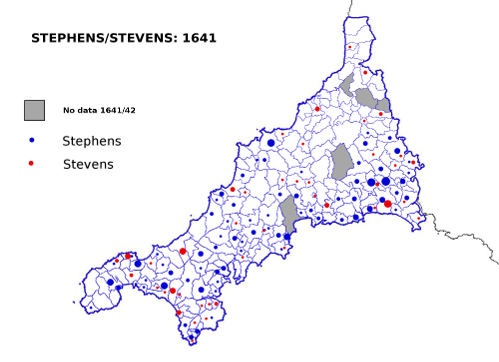
A majority of Stephen/Steven bearers had rather quickly added an extra <s> to their surname by 1641. Meanwhile, the vernacular spelling with a <v> had spread more widely, this being probably a function of the more secular nature of the source document.
In contrast, in the 18th century parish registers we find that the proportion spelt with the more learned <ph> rose again, leaving Stevens stranded in the St Ives district.
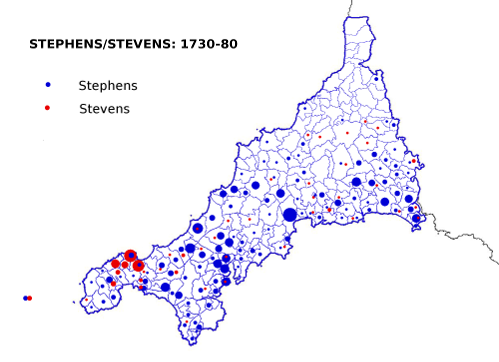
That established the pattern for the modern period, with Stevens taking precedence in the far west and Stephens dominant everywhere else. Because the <v> form ended up concentrated on St Ives and West Penwith it became seen as more ‘Cornish’.

 Cornish studies resources