Today is the 106th anniversary of the Redruth butter riot of 1920. Let’s disinter it from the graveyard of history.
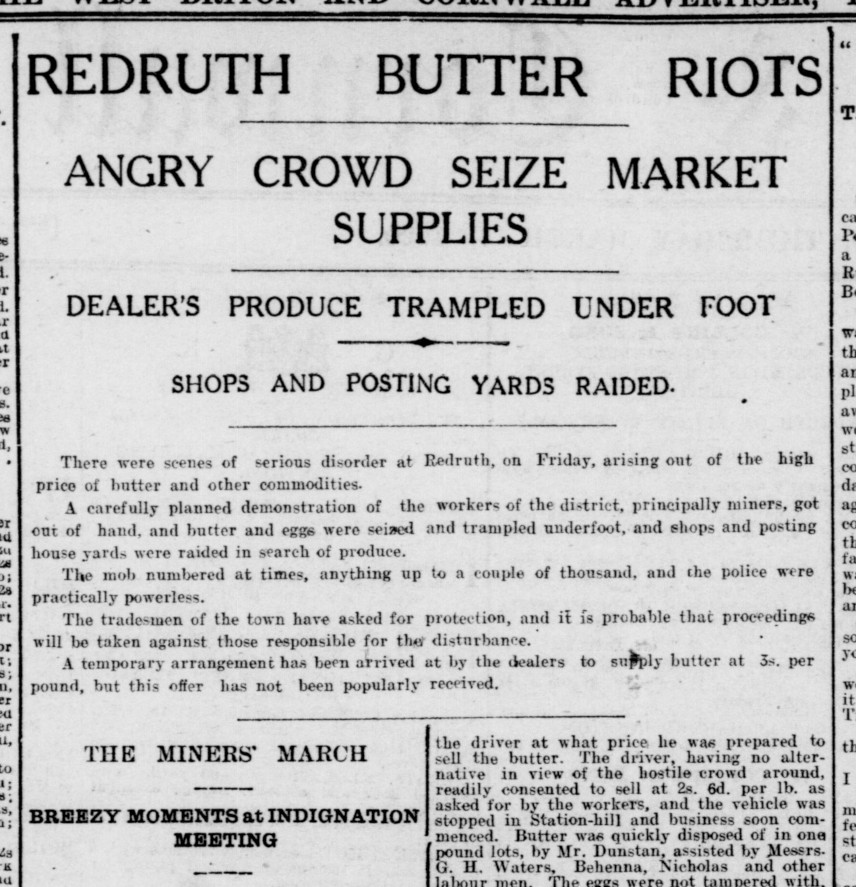
During the first World War, the price of various foodstuffs was controlled by the Government. By 1920, it had been decided to end this control, with milk and butter prices being left to the open market at the end of January. Six years earlier, before hostilities, the price of butter had been 1/8 (one shilling and eight pence) a pound. Since that point it had risen by 50 per cent to 2/6 in the last days of control. At a time of general inflation wages had also gone up but were struggling to match the rise in prices. This was made worse by serious post-war unemployment and ongoing difficulties experienced by the local mines.
Ending price control would inevitably lead to a further rise in the price of butter. Local families and trade unions were not happy as butter was an essential ingredient for baking. Protest meetings were held up and down Cornwall, resolutions passed deploring the end of price control, while Jasper Richards of the Dockers’ Union claimed that ‘miners in the Mining Division [Camborne-Redruth] were discontented and there were rumblings of revolution’. On 7th February miners, clay workers and foundry workers in the St Just district had assembled and 300 of them marched to Newlyn demanding a butter price of 2/6 a pound be maintained. Local dairymen agreed to this on a temporary basis, knowing that the price of milk, and therefore butter, would begin to fall in the spring.
The unions in the Redruth district planned to emulate the success of their comrades down west. On Friday, 27th February, market day at Redruth, miners at East Pool, Tincroft, Tresavean and South Crofty struck work and, led by union officials, marched to Redruth. On their way the columns were joined by others. By the time the crowd had assembled to hear speeches at Station Hill in Redruth, it numbered up to 2,000. Feelings ran high and the union leaders were struggling to restrain the crowd.
Things rapidly got out of hand. Buses bringing butter and eggs to market were stopped and the contents either sold at 2/6 or handed out free to onlookers. A market dealer from St Keverne was ‘roughly handled’ when he refused to sell at a price lower than three shillings and had to seek shelter in a nearby tailor’s shop. At Trounson’s, the biggest grocer’s shop in town, a Workers’ Union member (W. Johns from Carnkie) intervened to prevent a ‘crowd of youngsters and a number of women’ ransacking the store in search of butter. Disturbances rumbled on into the evening.
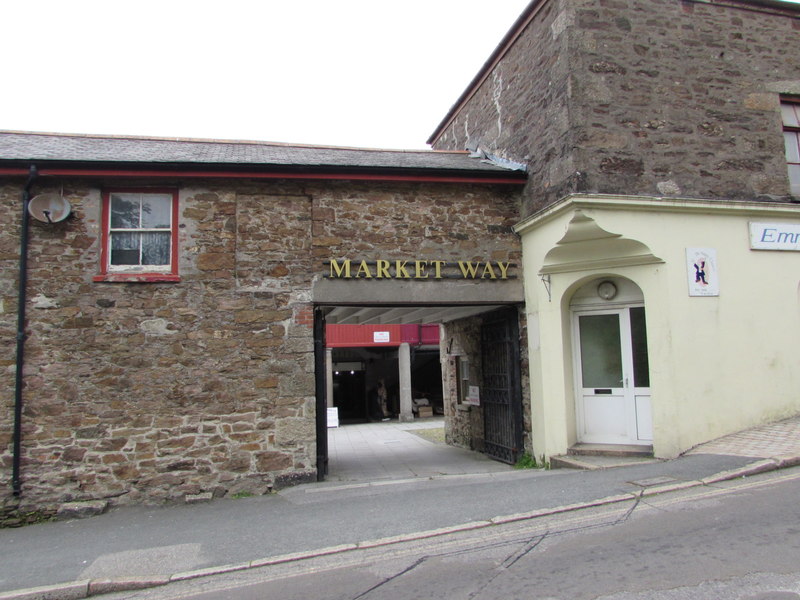
The ’butter riot’ at Redruth was perhaps the last instance of a traditional Cornish food riot. Were those involved in 1920 aware that they were following in the footsteps of their grandparents and great-grandparents? Previous generations in the mining communities were renowned for their willingness to resort to food rioting at times of scarcity. Indeed, Redruth market had been the scene of a major food riot in 1847.
If you have found the material on this site of use then you may be interested in my recent books published under the Coserg imprint. For a list see here.
 Cornish studies resources

There’s nothing worse than being a pedant, I know — but as someone who remembers the old currency, it’s a bit misleading to suggest that going from 1/8 to 2/6 is anything close to a doubling. In pre‑decimal terms that’s an increase from 20d to 30d, or in today’s money from about 8.3p to 12.5p. A hefty rise, certainly one people would have felt strongly about, but still a 50% increase rather than a 100% one.
LikeLike
Thanks for pointing that out – you’re correct and I’ll revise my sloppy maths forthwith
LikeLike
Fascinating to learn. Clearly a bread and butter issue for Cornish miners then. Thank you.
LikeLike