A couple of observations can be made about the pattern of male forenames in the 1520s that was revealed in the previous post.
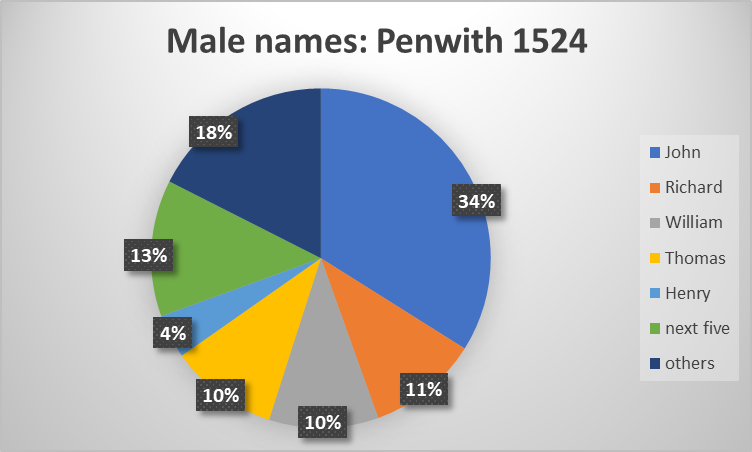
First, there was a clear difference between west and north Cornwall. The pattern in west Cornwall was somewhat more diverse with a greater variety of forenames. This was almost certainly the result of a tendency within the Cornish-speaking community to choose patronyms as names for male children, an echo of the Welsh naming tradition – as in Hywel ap Gruffudd ap Owain for example. In English speaking Cornwall, as in England itself, in this period godparents are assumed to have had more of a role in choosing the names of children, parents only taking over during the 17th century.
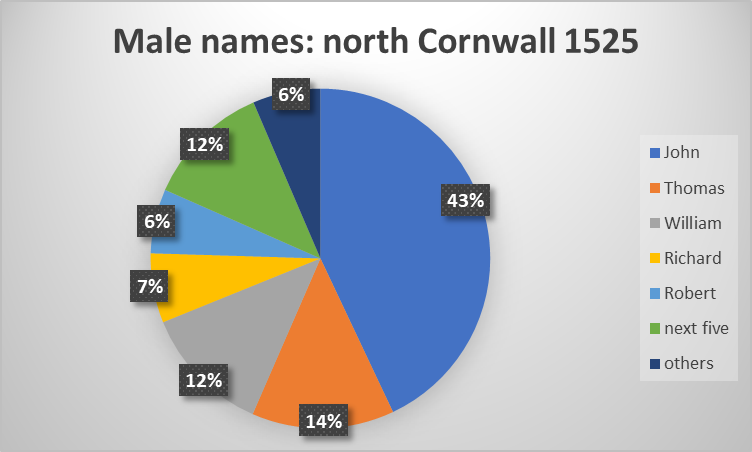
Yet, while the Welsh retained distinctive Welsh language versions of first names, Cornish did not. One solitary Hicca (Richard) in Penwith may be an example. A scattering of Pascoes in both west and north and a few Petrocs in north Cornwall could be taken as distinctively Cornish but, despite Cornish language surnames, there were no equally widely found Cornish language forenames. It might be argued that these were translated, so that someone called Myhal or Jowan appears as Michael or John in the records. But if so, why was this not also universal for surnames too?
The corpus of first names that we find in west Cornwall was shared with English-speaking communities. This implies that the general fashion of favouring saints’ names popular among the Normans had fully penetrated into the furthest reaches of Cornwall. It may be seen as more evidence for the presence of a distinctive hybrid culture in mid and west Cornwall, both Celtic and non-Celtic, retaining some Celtic aspects but embracing other non-Cornish elements, this hybridity probably having been established by the 12th century.
In relation to forenames, what is needed now is more analysis of differences by wealth as well as confirmation of the situation in the other Cornish districts and change over time. Meanwhile, the baptismal names given to girls are supposed to have been less restrictive than the limited handful of popular boys’ names. While the sources unfortunately do not provide an equally comprehensive list of female names, some hints can be gleaned from the lay subsidy of the 1520s. More on that in a later post however.
If you have found the material on this site of use then you may be interested in my recent books published under the Coserg imprint. For a list see here.
 Cornish studies resources