Some surnames formed from within the Cornish-speaking community and ending in -ow had a tendency for this suffix to shift from a written -ow to -a. For example, Higow was found also as Hicka, Mathow as Matta and Clemo sometimes became Clyma. How far the pronunciation of this unstressed syllable changed is another matter. The same occurred with surnames from places, Bussow becoming Buzza or Tregidgo tending to be Tregidga.
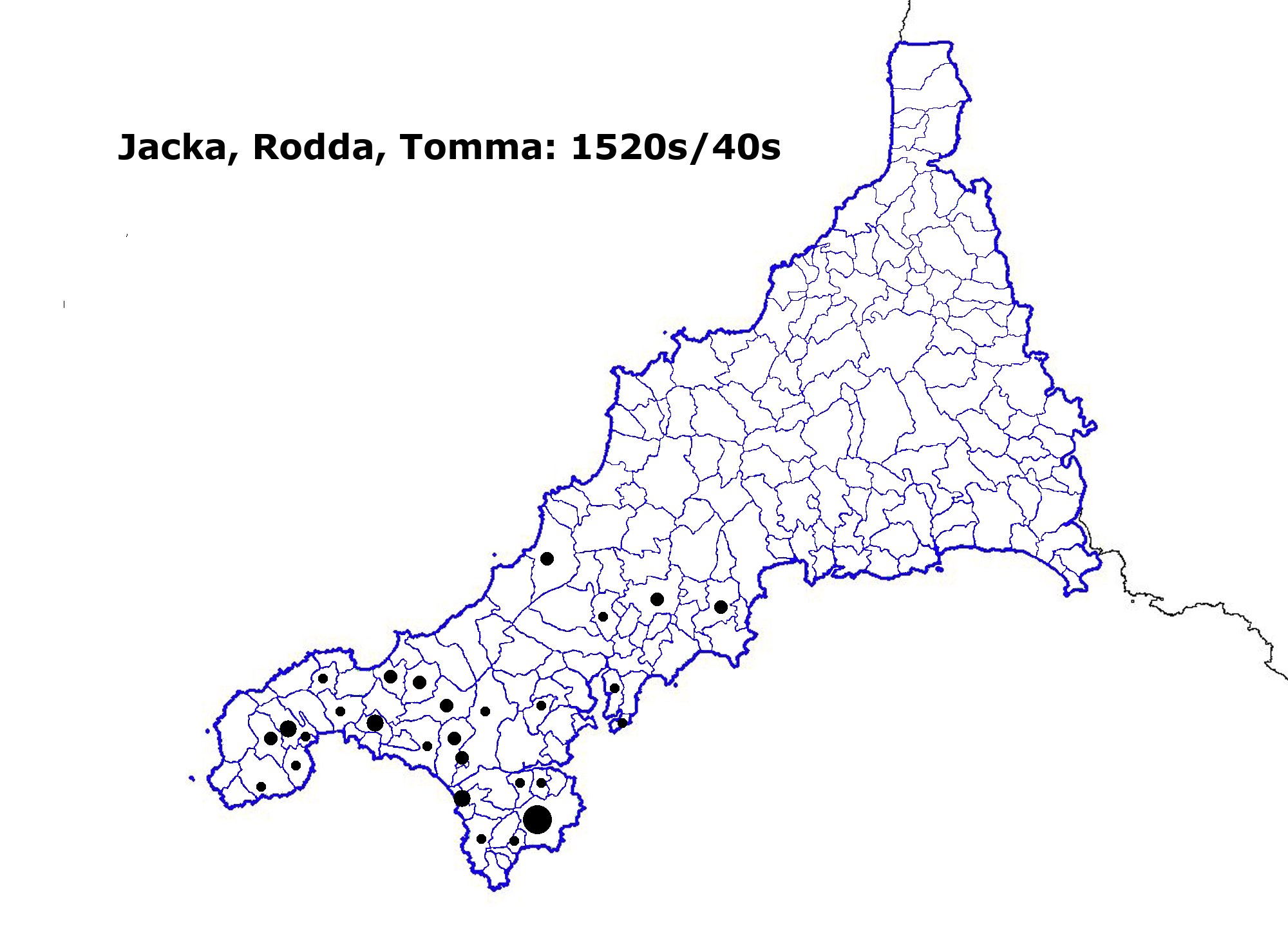
Yet not all surnames with an -a suffix were derived from Cornish -ow suffix patronymics or place-names. The names Jacka, Rodda and Tomma were, like the -ow suffix names, confined to west Cornwall in the early 1500s. We might be excused therefore for thinking these were also products of the Cornish-speaking community, a translation of the English -s suffix. Yet those names were never or rarely found as Jacko, Roddow or Tommow.
In fact, in the fourteenth and fifteenth centuries, the addition of a syllable to short, personal names (a feature known as inflection) was common in south-west England as well. But this practice died out there and even in Devon by the early 1500s the -a inflection had disappeared or become -er. The same process happened in English-speaking east Cornwall.
However, in the Cornish-speaking west and especially in the far west, examples of this feature were still common in the 1500s. As surnames became hereditary there, the -a inflection was retained into the 1500s, giving us Rodda, Jacka and the like, whereas in the east Rodd and Jack were becoming the norm. In this instance, as in many others, it was the presence of the Cornish language that made west Cornwall culturally different, a difference that echoes down to us over the centuries.

