By March 1801 the price of food in the market towns of Devon had reached an unbearable level. Residents began to adopt the by now familiar tactics of the food riot – imposing a maximum price at the markets and touring local farms with the aim of ‘encouraging’ farmers to send more grain to market.
Cornish mining communities, described at this time as ‘more in a state of independence and less subject to the influence of superiors’, needed no second invitation to join in. But the first place to see action west of the Tamar was not the mining west but the farming east. At the very end of March, a large crowd of women at Launceston seized some grain from a farmer and sold it at a reduced price.
This example was soon picked up elsewhere. By April 9th ‘rioting’ was being reported from Falmouth, where women again took the lead by insisting on a lower price for potatoes, and other places – Liskeard, St Austell, Helston, St Ives, Penzance and St Just were mentioned. A newspaper claimed that miners from Polgooth mine near St Austell ‘visited the farmers … carrying a written paper in one hand, a rope in the other. If the farmers hesitated to sign this paper … the rope was fastened around their necks and they were terrified and tortured into compliance’.

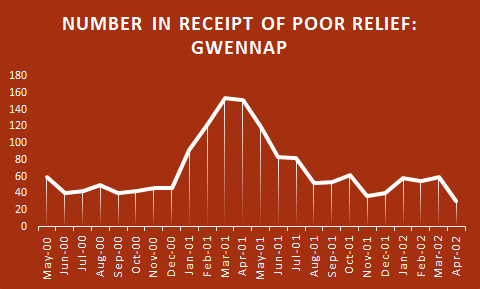
At Redruth, it was widely expected that the miners of Gwennap would take action at the next market. William Jenkin uneasily recorded the unrest drawing ever closer as ‘Gwennap mines pour forth their hundreds of desperate labourers who can with great caution and difficulty be prevailed on to be quiet.’ William’s forebodings proved prescient. Sure enough, at the next market he ‘had the disgusting sight of a riotous assemblage of tinners from Gwennap who broke into the market and are now compelling the people to sell potatoes, fish, butter and salt pork etc. at the prices they choose to fix.’ Not barley it should be noted as Redruth had lost its grain market following a previous food riot in 1773.
Some magistrates had sympathised with the demand for price controls but after a little hesitation decided on firm action. On the succeeding market day, the magistrates swore in 50 ‘principal inhabitants’ of the town to help protect it from the Gwennap miners. This they did, although the presence of a small detachment of soldiers was no doubt a factor helping to keep the peace.
After this, the tumult slowly subsided as more grain supplies arrived along with more troops. The local magistracy, which had temporarily lost control, regained it. The miners drifted back to work. Nonetheless, fixed maximum prices remained at Launceston for a month until May 9th and at St Austell for over three months until late July.
Fifteen people were charged with various offences although no one was hanged (unlike in Somerset where it was thought a couple of executions would set a good example). In Cornwall 13 were found guilty, with fines of up to £5 and/or two or three months in prison. It was presumably concluded that any more draconian ‘examples’ would serve merely to inflame the populace once more.
The costs of maintaining this website are constantly rising. If you’ve enjoyed it then making a small donation would help to keep it ad-free.

