Who was Piran or Perran and why is he celebrated? The actual St Piran, if there ever was one, proves to be a little elusive. The cult of Piran was venerated at Perranzabuloe in the eleventh century and spread to other sites at an early date. But the Life of Piran, written in the 1200s, 700 years after Piran was supposed to have lived, was plagiarised from the Life of the Irish saint Ciaran, who lived for 200 years and retained all his teeth while avoiding the infirmities normally associated with old age. And all despite his habit of praying when standing or kneeling in water.
Like all saints, while in Ireland Piran conducted a whole range of miracles. He raised various servants from the dead, fed ten kings and their armies on just eight, or sometimes three, cows, turned cold water warm and water into wine, carried fire in his bare hands without getting burnt and the like. Of less useful material benefit was his ability to make a stork sing, cause snow to fall or make any meat ‘seem diverse in taste’. Having retired to Cornwall, Piran seems to have been an early version of Dr Doolittle, conversing with animals and converting a fox, badger and bear. He survived long enough to build a mansion before his passing, when his ‘soul pierced the heavens with exceeding brightness’.
Teeth or no teeth, Piran clearly had a relatively high status in the saintly pecking order, giving his name to three parishes in Cornwall. Nicholas Roscarrock devoted a long entry to him in his Lives of the Saints in the 1610s. During Rogation week in April and May the canons would lead a procession of parishioners to the boundaries of the parish, carrying a cross, banners including depictions of a dragon and any relics of Piran that they happened to possess. Nicholas remembered the last of these processions in the reign of Mary in the 1550s. At that time, the Perranzabuloe procession would meet up with similar processions from Newlyn East, Cubert and Crantock at a chapel in Newlyn East.
Piran also discovered tin, which seeped out of some rocks that he’d magically set on fire. However unlikely that was, Piran became the patron saint of tinners. While the Reformation put paid to the annual parading of Piran’s relics around the parish, St Piran’s feast day on March 5th continued as a miners’ holiday in the west. On this day games such as wrestling and hurling would be organised and considerable drinking indulged in. By the 1800s this had produced the phrase ‘as drunk as a Perraner’.

However, with the decline of mining after the 1860s Piran’s feast gradually faded. By the 1950s the day was hardly noticed outside Perranzabuloe. However, in the1980s it began its revival to become the major cultural celebration of Cornishness.
This was largely due to the adoption in the 1950s by Cornish revivalists of the black and white St Piran’s flag as the flag of Cornwall. The folklore collector Robert Hunt had in the 1860s described the simple white cross on a black background as the ‘device of St Piran’ and the ‘standard of Cornwall’. Its advantage lay in its simplicity, lending itself to the explanation that the black represented the black tin ore while the white was the smelted metal.
In the 1960s St Piran’s flag was derided as ‘MK’s flag’. Yet, it began to infiltrate the mainstream in the 1970s as the native Cornish reacted against mass in-migration from east of the Tamar and looked around for resources with which to reassert their Cornishness. St Piran’s flag was perfectly placed and by the 21st century had become the immediately recognisable and taken-for-granted emblem of Cornwall, adopted by businesses and even accepted by government.
In the 1980s and 1990s processions began to be seen on St Piran’s Day, first at Truro and then across the dunes at Perranporth. Here, a play about Piran was performed on a promenade from the holiday camp to the parish church that had been abandoned to the sands in 1804. Alan Kent pointed out how this was a re-invention with a powerful sense of place, taking place just a mile or two north of Perran Round, a plain an gwarry where an original but lost Life of Piran may well have been performed on his feast.
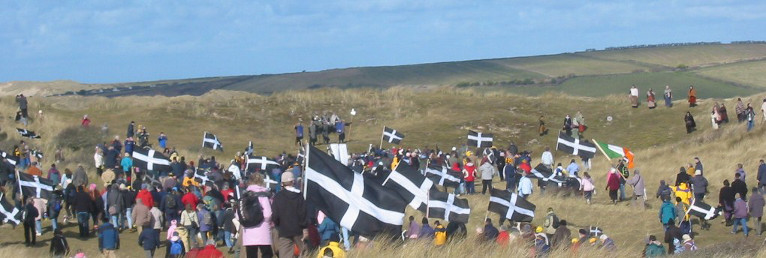
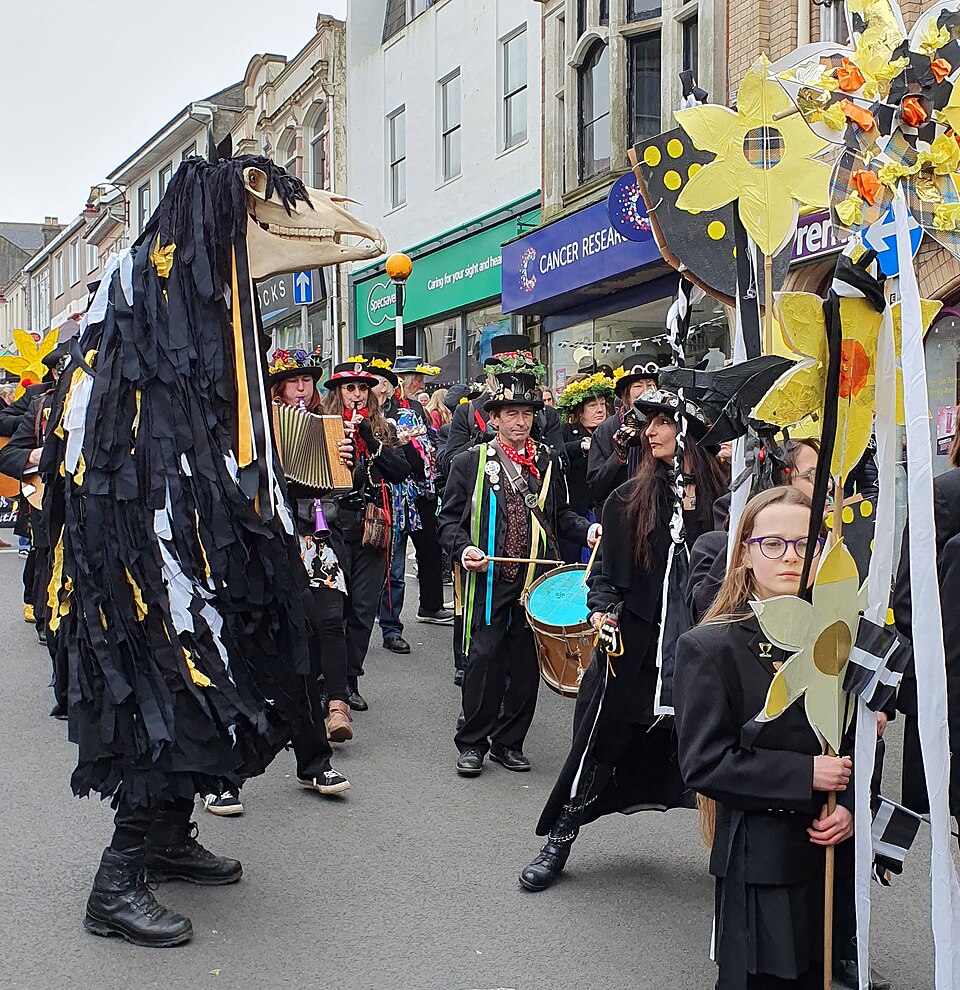
Since then St Piran’s Day has gone from strength to strength, with events taking place in Cornish towns from Penzance to Lanson and among Cornish communities overseas. The parades and processions echo those of Catholic Europe. At Redruth, in a conscious evocation of earlier traditions, a giant lamb (the lamb and flag being a common symbol used in tin smelting) is paraded around the town. Meanwhile, older festivals such as the Hal an Tow at Helston and Padstow’s Obby Oss incorporate references to Piran and have adopted the ubiquitous St Piran’s flag. All this gives St Piran’s day, in reality a relatively recent reinvention, in Kent’s words, ‘an illusion of timelessness’.
(This post is a revised version of those appearing on March 5th, 2020 and 2024)
If you find the material on this site of use then you may be interested in my recent books published under the Coserg imprint. For a list see here.
 Cornish studies resources
.jpg)
You might see the funny side of this, somewhat irreverant, but honest.
The coat of armes does go back 1100 years whilst the flag might be reinvention, and whilst Perran/Piran did claim to have discovered tin, even pre Roman times Phoenicians, Greeks and other visited Kernow to trade for tin as it was already being mined along with copper as long as 4 000 years ago, the visitors wrote in their annulls about their positive expereince trading with the natives.
Wonder if my teeth will last 200 years, must have been the clotted cream…
Sent: Thursday, March 05, 2026 at 7:43 AM
LikeLike