James Harris, ‘Language, historical culture and the gentry of later Stuart Cornwall and south-west Wales’, Historical Research 95, 269 (2022), pp. 348-369
Attempts to revive the Cornish language began a century or more before its last speakers expired. In this article James Harris examines the small coterie of enthusiasts based in West Penwith in the decades either side of 1700 who collected fragments of the Cornish language while producing some writings of their own. These are placed in the broader context of the construction of regional identities by local gentry antiquarians and compared with the state of affairs in south-west Wales.
In recent times we have become more aware of the important role of William Scawen (1600-89). In his final years Scawen worked on his Antiquities Cornu-Brittanic, which painted a picture of the Cornish as ‘ancient Britons’. For Scawen, they were like the Welsh, separate from the English in terms of origins, history and in particular language.
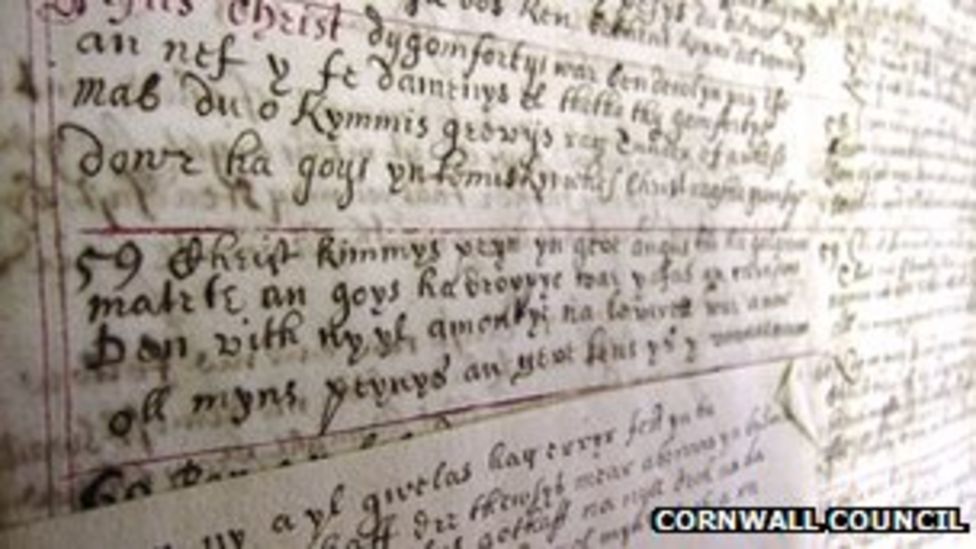
Scawen, although himself an English-speaker based in south-east Cornwall, had kin connections to the Keigwin family of West Penwith. Through this his work on the old language helped to focus the enthusiasm of a small group of minor gentry in the far west with an antiquarian interest in Cornish. This shifting group of never more than eight men were keen to resuscitate the language as much as mourn an increasingly obvious ‘terminal decline’.
That decline was partly ascribed by Scawen to the disinterest of most of the Cornish gentry. This was well illustrated around 1700 when Edward Lhuyd sought subscriptions to help finance the research and publication costs of his tour of the Celtic countries. The vast majority of subscribers were Welsh with just seven (or four per cent) from Cornwall. However, it should be noted that the gentry of English-speaking south Pembrokeshire were equally unmoved by Lhuyd’s appeal.
James Harris explains the ‘straightforward lack of interest’ from most of Cornwall’s major gentry as flowing from their lack of knowledge of Cornish, disparaged by most as an inferior and unintelligible jargon only used by the vulgar sort. The contrast with Carmarthen and Ceredigion in Wales was stark. There Lhuyd’s work was welcomed as a 90 per cent Welsh-speaking population made it instantly more relevant to understand the history and origins of the Welsh language. In addition, non-antiquarian motivations were at work. More general social cachet could be gained in rural Wales through association with Lhuyd’s work. Meanwhile, the Anglican clergymen who dominated the ranks of local antiquarians could see the value of Welsh in evangelising the local population.
Although the regional identity embraced by Cornish antiquarians such as Scawen and the West Penwith group was similar to that in Wales, its reception therefore differed. Nonetheless, the image of the Cornish as ancient Britons endured into the 19th century in some quarters and to an extent became popularised. Meanwhile, even among the gentry there was no ‘uniform regional identity’ but a ‘spectrum of responses’ to the work of local antiquarians.
The Cornish revivalists of the late 17th and early 18th centuries have often been pilloried for failing to collect the living vernacular of the last generations of Cornish-speakers around them. This may be a little unfair. For those of us who prefer the Cornish of the later, more modern period to the medieval revived Cornish of the 20th and 21st centuries with its base in the 14th century, it‘s poignant to read that Willam Gwavas was supposedly collaborating with Thomas Tonkin of St Agnes on a Cornish vocabulary in the 1730s. But sadly it was never published.


An excellent review. A great pity that Thomas Tonkins work was never published. I assume no note of his work were left anywhere?
LikeLike