We interrupt this series on Cornwall's top 20 surnames to bring you news that a new edition of The Surnames of Cornwall is now available as an e-book, paperback or hardback. For further details see here. Normal service will be resumed tomorrow with Cornwall's 8th most common surname.
Tag: Cornwall
New edition of The Surnames of Cornwall – an update
A new, updated and revised edition of The Surnames of Cornwall should be available by August 19th includes an extra 100 surnames 43 more pages 20 more maps e-book, paperback and, in some places, hardback versions Further details and provisional pricing can be found here, along with details of my other books. Here are some … Continue reading New edition of The Surnames of Cornwall – an update
Coming soon: a new edition of The Surnames of Cornwall
This month I shall be publishing a new revised and extended edition of The Surnames of Cornwall which, as of today, will be temporarily unavailable online. For the first time, this book will also be available in hardback. The updated edition includes a further 100 surnames distinctive to Cornwall, bringing the total to around 850 … Continue reading Coming soon: a new edition of The Surnames of Cornwall
Dumnonia: Region? Kingdom? Or at times both?
In the new edition of Cornwall’s First Golden Age the most extensive changes occur when discussing the earliest period – the fifth and sixth centuries. The original chapter 2, with some material from later chapters and new content, has been restructured into three separate chapters focusing in turn on Tintagel, Dumnonia and the issue of … Continue reading Dumnonia: Region? Kingdom? Or at times both?
Cornwall’s First Golden Age – new edition out now
A new edition of Cornwall's First Golden Age - the critical synthesis of the history of Cornwall in its period of independence and initial colonisation from the 400s to the 1100s - is now available, back by overwhelming public demand (or at least a handful of requests). Revised, considerably restructured and updated to include the … Continue reading Cornwall’s First Golden Age – new edition out now
Spelling variants and Cornish surnames: Cliffs and Curnows
Let’s catch up on a couple of surname queries, both of which involve spelling variants. The first is the name Cliff. There is general agreement that this is a topographical name, one taken from a feature in the landscape. The classic surname dictionary by P.H.Reaney confidently proclaims that Cliff and Clift are both variants of … Continue reading Spelling variants and Cornish surnames: Cliffs and Curnows
Deprivation in Cornwall: new data
Recently a new Index of Multiple Deprivation was published by the Government. This index measures deprivation in several dimensions, including income, health, educational qualifications and crime among others. In the press reports of this, no comparison was made with earlier indices. Although the methodology has changed somewhat, which makes the exercise a little difficult, it’s … Continue reading Deprivation in Cornwall: new data
The Levant mine disaster
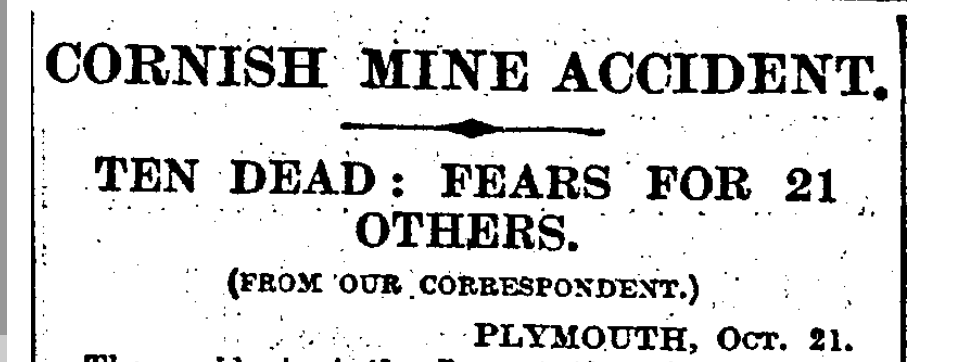
A hundred years ago today the man engine collapsed at Levant mine, Pendeen, near St Just. This was the second worse mine disaster in Cornwall’s history. Thirty-one miners lost their lives and many others were badly injured. The man engine was a device that conveyed miners to and from the surface, allowing them to avoid … Continue reading The Levant mine disaster
Three golden ages and six turning points: a history of Cornwall in 500 words
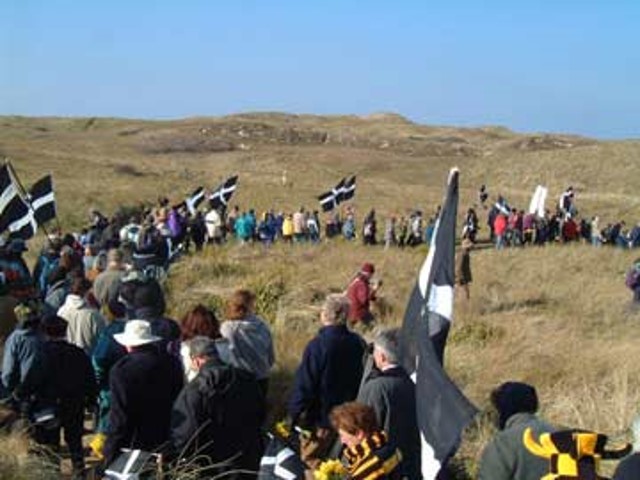
Yesterday, I was asked to give a short talk on the history of Cornwall. How do you sum up 2,000 years of history in 45 minutes? Tricky. This was my attempt. A golden age is a period of victory or defeat (or both) which later becomes mythologised and looked back on with pride. A turning … Continue reading Three golden ages and six turning points: a history of Cornwall in 500 words
A miner on the move
In 1862 a Parliamentary enquiry into the condition of metal miners interviewed several miners in Cornwall. Their life histories provide a fascinating insight into their moves from mine to mine. They indicate that miners moved frequently. One of the most extreme examples was an anonymous miner at St Cleer. Aged 36 in 1862, he had … Continue reading A miner on the move
 Cornish studies resources