
Daniel Brookes ‘‘The view is nice, but you can’t eat it’: A poetics of precarity in Bait’ (2019), Dir: Mark Jenkin’, in Michel Rys and Liesbeth Francois (eds), Re-imagining Class: Intersectional perspectives on class identity and precarity in contemporary culture, Leuven UP, 2024, pp. 241-54.
What can Mark Jenkin’s acclaimed film Bait tell us about class relations in coastal Cornish communities? According to this contribution quite a lot. For Daniel Brookes, the central tension of Bait is the simple contrast between Martin, the impecunious local fisherman without a boat and the second home owning gentrifiers from upcountry who bought Martin’s family’s former cottage and with it his heritage. Meanwhile, he is consigned to social housing well out of sight on the margins of the village.
The context of Bait is familiar enough. The rise of rentier capitalism and of a visitor economy with its second homes and holiday lets has radically altered the long-standing relationship between place and people. In consequence Cornwall’s coastal villages have been hollowed out as a widening housing affordability gap and economic inequalities make access to a secure income and decent housing by many locals a thing of the past.
Brookes locates Martin’s predicament as an aspect of the rise of the precariat, that class existing below those who can rely on a steady income. Instead, the precariat is forced to rely on part-time or temporary work, low paid or paid by piece rate, on flexible or zero-hours contracts. Its emergence has been associated with the breakdown of traditional class solidarities, replaced by individualised struggles to survive corporate neo-liberalism.
Hitherto, studies of the precariat have been firmly located in urban contexts. Instead, Bait offers a view of ‘precarity and the pastoral’, the new class structure in rural conditions, in places imagined as an idyllic contrast to the urban. These are locations where the ‘view’ is ‘fetishised’ and ‘idealised’ by those with greater financial power and consequently the freedom to buy it.
In a close analysis of the film techniques adopted in Bait Brookes shows how its director Mark Jenkin forged a connection between the precariat fisherman and his artistic practice, linking the art with the external social structure. However, Bait is not a work of social realism in the footsteps of Ken Loach or Mike Leigh. In contrast, it explores ‘unexplained emotional tonalities of precariat experience’ by using experimental sound and visual devices to outline a ‘new poetics of precarity’.
This is a convincing analysis and neatly connects the aesthetic dimension of Bait to class relations. Nonetheless, the conclusion – that the film reflects an ‘ongoing unfolding of uncertainties’ leaves us adrift with only a gloomy and pessimistic prognosis. Where are the opportunities for the precariat to make their own history by combining against their exploitation?
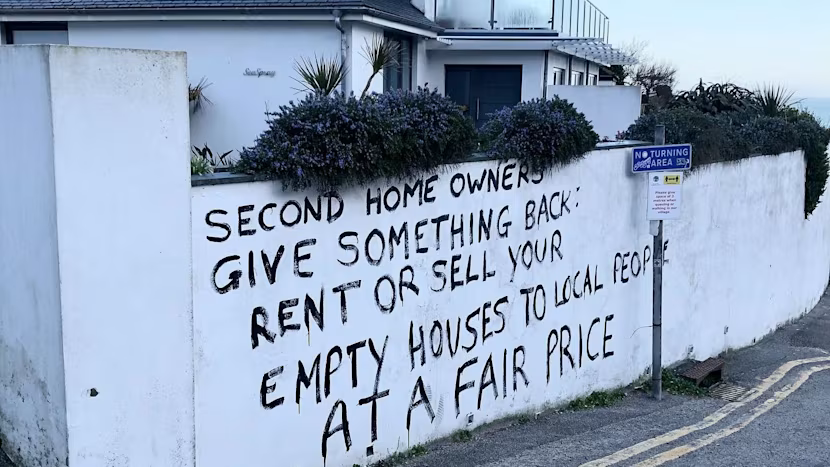
Perhaps there are none. But we should also remind ourselves that de-industrialised Cornwall has a long history of ‘making-do’ and ‘getting-by’. Past generations adopted myriad strategies for coping with the loss of secure employment and are hardly unaccustomed to the anxieties of a ‘precariat’. Maybe there are historical lessons that remain to be re-learnt from Cornwall, at the leading edge of precarity just as it was of industrialisation and de-industrialisation.

