
Marc Scully, ‘Challenging peripherality: Cornwall in pan-Celtic narratives of place’ in Roberta Piazza (ed.), Discourses of identity in Liminal Places and Spaces, Routledge, London, 2019, pp. 147-65.
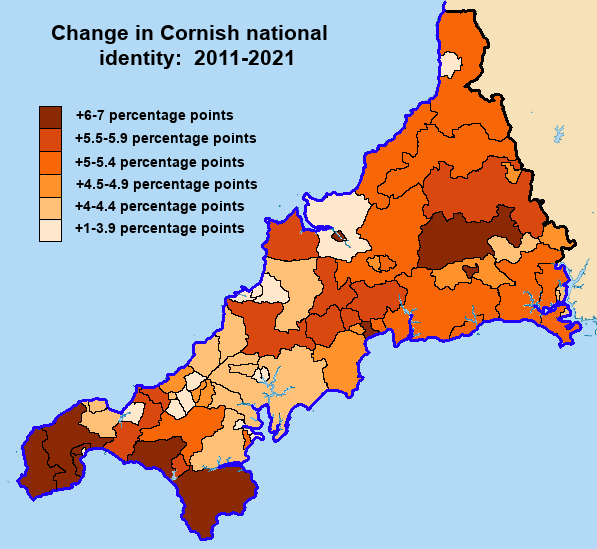
There is a strong suspicion that the number of people in Cornwall adopting an oppositional identity – i.e. Cornish not English – rather than a nested identity – both Cornish and English – has been on the rise since the turn of the millennium. This coincides with, although is not caused by, a wider appeal of Cornish cultural revivalism, music and dance in particular and greater prominence for the revived Cornish language.
The rise of oppositional narratives and Cornwall’s Celtic festival culture are brought together in this book chapter by Marc Scully. Like Benjamin Schlink’s work on nationalist identities, Scully’s chapter is based on interviews conducted in 2013. Unlike Schlink’s it involved a greater number of interviewees and a more explicit emplacement in a ‘Celtic’ context.
Scully situates Cornwall as a ‘liminal’ place, one that potentially contains ‘more than one opposite national category simultaneously’. Those who choose to hold to an oppositional identity have to negotiate challenges from two directions. First, there is the familiar hostility from the competing narrative of Englishness. But in addition, there is a lingering fear that the Cornish might also be peripheral within the Celtic margins. This is well illustrated by Ian Stewart’s recent book on the emergence of Pan-Celticism, where Cornwall and the Cornish receive only fleeting mentions.1
The data for the chapter was collected over three nights spent at the 2013 Lowender Peran (now just Lowender) Festival, a major event on the pan-Celtic festival circuit. Interviewees were asked how they took up their subject positions as Cornish and/or Celtic and their assumptions about others who shared their identity. From those conversations Scully was able to propose three ways around which identity was organised by festival participants.
The first was a clear distinction between Cornishness and Englishness. This was a non-negotiable position. In contrast to earlier Cornish cultural revivalists the present generation partakes more of historical victimhood. English oppression is taken for granted, providing a more comfortable explanation for Cornwall’s current woes. But identities are not about the past as it actually unfolded but about the use of the past in the present. And this has to be reproduced anew in each generation. Scully points to this ‘identity work’ by festival participants and claims to detect a generational shift among ‘entrepreneurs of identity’.
While Cornwall’s historical subjugation is a non-negotiable assumption, the other two expressions of Cornishness – the construction of authentic Cornishness and Cornwall’s place within the pan-Celtic spectrum – are more open to negotiation. These provide space for more personal expressions of Cornishness that are nonetheless ‘authentic’. Furthermore, festivals such as Lowender are sites that allow participants to draw on narratives of pan-Celtic solidarity. This then feeds back more widely into music and dance performances and re-centres Cornwall as Celtic, but not as part of a fringe.
The more prominent agency of what Scully terms cultural entrepreneurs and a proposed generational shift is an interesting conclusion. Yet precisely how new is the emergence of more hybrid forms of Celtic-Cornish identity that this chapter claims to detect? Surely, such trends have been present for at least a half century since the 1970s.
- Ian Stewart, The Celts: A Modern History, Princeton UP, 2025 ↩︎

