
Benjamin Schlink, ‘The construction of Cornish identity’ in Frauke Reitemeier (ed.), Transfers and Transmutations, Universitätsverlag Göttingen, 2015, pp. 231-66.
Most academic accounts take the concept of identity as a given, once a convenient descriptor has been appended, for example national, regional, local, British, English, Cornish identity. Despite that, the consensus is that identities are not essentialist. They do not come down to us over time unchanged from supposedly pure origins. On the contrary, a variety of models and theories explain how they have been reproduced in the present by narratives of the past and are liable to change over time.
German academics have had a long and honourable interest in the Celtic countries, including Cornwall.1 In this chapter Benjamin Schlink discusses how Cornish identity is constructed and represented. While the strength or extent of identity or the role of identity in politics or economics is a well-ploughed field there has been less work on what we might call the content of identities, the stuff that those who claim an identity refer to.
In practice however, Schlink did not study Cornish identity in the round but the identity of Cornish nationalism, this based largely on in-depth interviews with two Cornish nationalists. Collapsing Cornish nationalism into Cornish identity is not uncommon among outside observers. They are more likely to be fascinated by the more romantic and exciting Cornish revival than the lived, everyday identity of those who, while defining themselves as Cornish, may express little explicit support for nationalist aims or even awareness of the Cornish as a nation.
Nonetheless, Schlink’s two interviews conducted in 2013 with a former MK town councillor and a Cornish language activist open up a window into their Cornishness while hinting at some possible faultlines within the nationalist identity. Schlink concludes that for both the core of their identity claims resides in the Cornish language. This may seem odd as less than one per cent of Cornish residents are competent in that language. However, as the salience of other distinctions – a metal mining economy, revivalist Methodism, the Anglo-Cornish dialect, rugby football – are eroded the Cornish language has taken on more importance as an aspect that cannot be co-opted into Englishness. Here is something that is indubitably ‘ours’ and only ours.
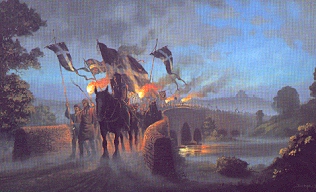
Both interviewees also cited a distinct history as a key component of Cornishness, echoing the notion of ‘usable pasts’. Cornish history clearly provides such a usable past, a resource to be re-interpreted and narrated as part of performing Cornishness. For the second interviewee this involved a heady brew of historical suppression, victimhood and minority status and a vigorous re-statement of what we might term the myth of 1549. This involves the idea that the conservative religious rising of that year was a proto-national revolt, resulting in the wholesale massacre of Cornish speakers and ultimately the loss of the language.
The final strategy identified by Schlink was the importance of the boundary of the Tamar and the Cornish people’s entitlement to self-government within that boundary. We might sum up the core of a Cornish nationalist identity therefore as language, history and border. What would be interesting now would be wider qualitative research on identity narratives beyond nationalists, for example either natives or non-natives adopting the ‘civic’ Cornish identity that MK signs up to or native part-time ‘rugby patriots’ who at other times embrace English nationalism. More comparative work on the changing ‘stuff’ of Cornish identity is always welcome.
- see Malte Tschirschky’s untranslated Die Erfindung der keltischen Nation Cornwall: Kultur, Identität undethnischer Nationalismus in der britischen Peripherie. Heidelberg, 2006 ↩︎

