Hilary Orange, ‘Uneven surfaces: Bodily engagements with the postindustrial wild’ in George S. Jaramillo and Juliane Tomann (eds), Transcending the Nostalgic: Landscapes of Postindustrial Europe beyond Representation, Berghahn Books, Oxford, 2022, pp. 44-63.
Hilary Orange turns her attention here to a novel aspect of Cornwall’s post-industrial landscape during a period which will ring a number of bells for Cornishmen (but not as many Cornishwomen) of a certain age. In this book chapter she shifts her gaze away from the heritage industry’s fondness for ruined buildings and physical structures to concentrate on the finer details of the surfaces of disused mines, the way these minescapes were used and the sensory experiences of those using them. In doing so she recaptures a phase of cultural life now fast disappearing if not largely gone.
Derelict mines were never just vacant unused space. They were used for waste disposal (both on and under ground), scavenging, mineral collecting and as playgrounds for teenagers and children. Unregulated, the ‘postindustrial wild’ survived as edgelands, located at the margins of villages and towns or on moorland and other rough land safely distant from urban life. Walking through such edgelands at Botallack and St Agnes, Hilary Orange reflects on the former uses of this land, regarded as a type of common land by locals but with an additional role in soldering people’s attachment to place.
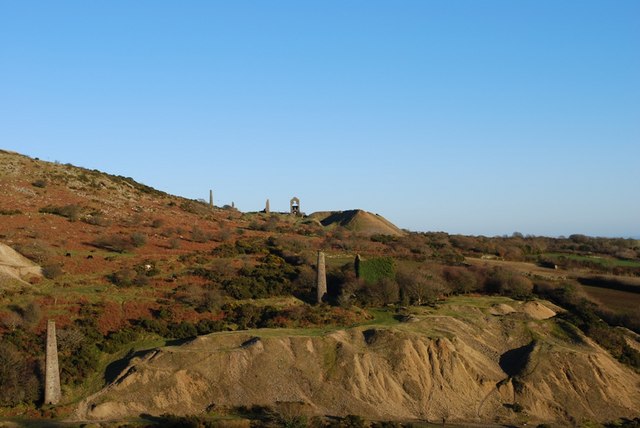
De-industrialised landscapes were also never static nor unchanging. Revegetation occurred, travellers came and went, waste dumps were re-examined as tin prices periodically (and temporarily) rose. However, for a space of time, two or three generations at the most between closure and the late 1900s, the postindustrial wild played a key role in the bodily experiences of men who grew up in their vicinity. They were places of recreation, exploration, creativity, not to mention convenient, if not exactly environmentally sound, opportunities for waste disposal.
But then, as in so many other instances, in the 1980s things began to change. The rusting cars were removed, shafts cleared of rubbish and capped, ‘semi-hostile’ surfaces rendered safe for dog walkers. Derelict tin and copper mine sites began to be viewed as potential gold mines for heritage tourism. Simultaneously, economic shifts led to the removal of some dumps and safety concerns to the flattening of others. As Orange puts it, verticality was reduced as underground access was restricted and burrows were truncated. A narrowing of horizons that can be seen as carrying all manner of other metaphorical implications.
This process reached its climax in 2006 with UNESCO designation of Cornwall’s postindustrial wild. Somewhat paradoxically, visual reminders of the demise of mining were modified or removed and a more leisure-orientated and sanitised landscape created. Although the hoped for tourism bonanza has not materialised, the postindustrial wild has shrunk. What was, for a short time, a unique component of local lives, at least for men, has in many places been erased with it. The postindustrial wild, an under-recognised and under-regarded facet of Cornish life, has no place in the profit-driven processes of urbanisation and gentrification that are creeping remorselessly across Cornwall.


