Edward Gillin, ‘Mining knowledge: nineteenth century Cornish electrical science and the controversies of clay’, History of Science 62.2 (2024), pp. 202-26.
During the 1820s and 30s Michael Faraday (1791-1867) established his reputation as a pioneer of electrical science. His work was based on laboratory experiments and disseminated through the normal scientific journals and lectures to polite society centred on London. At the same time Robert Were Fox (1789-1877) was investigating electromagnetic phenomena in Cornwall seeking an explanation for the formation of ore bodies. While his theory that these were formed by electric currents produced by heat was accepted by geologists by the 1850s Fox encountered considerable difficulty in convincing scientific elites that his experiments were sound. Majority opinion remained sceptical about the naturally occurring subterranean electric currents that Fox claimed to have discovered.
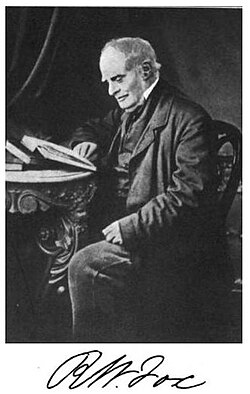
In this article Edward Gillin detects a ‘distinctly Cornish approach to the study of electricity’. However, it was one that was also difficult to communicate as Fox’s claims were hard to verify. His experimental approach was at odds with received opinion of the time. Instead of replicable laboratory experiments they were based on examining nature directly by measuring temperatures and electrical currents underground. Fox was utilising the mine as an alternative to the private laboratory and lecture theatre of elite science. As Gillin puts it, the planet itself was his laboratory. But such methods were not easily duplicated and consequently there was a reluctance on the part of established scientists to accept them as valid.
Fox had to adopt two strategies to overcome this resistance. The first was social networking. Although as a Quaker Fox was excluded from university, he enjoyed a very respectable social status as a member of one of Cornwall’s leading landed families, advantages that Faraday had not had incidentally. He was able to use his social connections to meet a number of influential persons at a succession of country house dinners. Moreover, he was able to tap into the Cornish network already present at the heart of London’s scientific community in the likes of Humphry Davy and Davies Gilbert. With their support he was elected Fellow of the prestigious Royal Society in 1848.
His second strategy was to develop a technique to model the action of electric currents in metalliferous mines on a small scale by using clay samples. These were portable and allowed him to transport observations made in mines to the ‘spaces of polite scientific discussion’. Nonetheless, there remained limits to the credibility of Fox’s work. Faraday for one remained unconvinced, leading Gillin to conclude that Fox had found it more difficult to communicate his findings horizontally beyond Cornwall than it had been to descend vertically into the depths of mines.
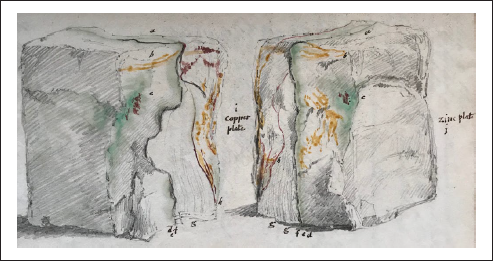
in 1838 (Image by Michael Carver, 2023).

