Nicola Jane Gentle, ‘Three late fifteenth-early sixteenth century chapel furnishings belonging to the Edgcumbe family in Cornwall’, The Antiquaries Journal 104 (2024), pp. 145-68.
Religious embroideries only rarely survived the Protestant Reformation of the sixteenth century. One exception is to be found at Cotehele, now a National Trust property and formerly the property of the Edgcumbe family on the banks of the Tamar at the far eastern edge of Cornwall. In the domestic chapel at Cotehele there are three pieces of textile embroidery, an altar cloth of Christ and his apostles, what has been described as a mourning hanging with figures of the saints, the prophet Jeremiah and Michael overpowering Satan. The final piece is different – an embroidered pattern with a repeated motto.
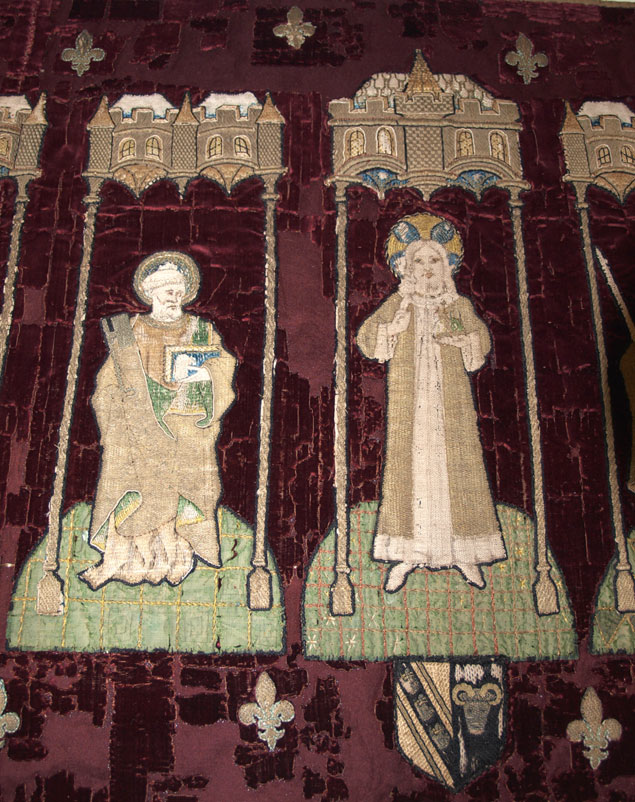
Nicola Gentle dates these textiles to the 1490s on the evidence of the technique employed. This is reinforced by the presence of the arms of Sir Piers Edgcumbe and his wife Joan on the altar cloth – they were married in 1493 – and monograms of Piers’ father Richard (died 1489) and his wife, also Joan, on the motto cloth. The chapel had been rebuilt within the house by 1489, which might suggest a date around 1490 with the embroideries created specifically for the chapel.
Apparently, embroidery techniques became simpler and more standardised after the 1350s and the Black Death. Was this owing to a shortage of skilled embroiderers after that demographic disaster? Whatever the reason specialised workshops emerged in London in the fifteenth century. These prepared elements that could then be bought and assembled locally. However, it’s not known whether the Cotehele embroideries were a product of the London workshops or local craftspeople.
What particularly strikes an observer with little or no knowledge of embroidery is the mobility of these furnishings. From accounts of the house written by visitors in the eighteenth and nineteenth centuries Nicola Gentle reconstructs their location in the house. They, or parts of them, were moved regularly from the 1790s to the 1840s from room to room, possibly to protect them from damp. She also speculates that the entire set of cloths may have been transported to the newer family seat at Mount Edgcumbe and then moved back to Cotehele when Mount Edgcumbe was modernised in the 1740s. Moreover, the figures on the embroideries were sometimes unpicked and re-set on other backings in a process that was anything but static and stable.
How had they survived when so many other textile hangings with a religious theme were destroyed or re-used as chair coverings and the like after the 1500s? Gentle concludes that their survival owed itself to the early antiquarian interest of the Edgcumbe family who viewed Cotehele as a historic building worthy of preservation from as early as the mid-1700s.
Another possible explanation could relate to the religious and political affiliation of the Edgcumbes in the 1500s. As staunch supporters of the religious reforms pushed through in the 1530s and 40s and thereafter, the family was unlikely to have received the attention the Elizabethan authorities gave to more suspicious recusant families. In consequence their historic furnishings were left to moulder quietly away and become a modern rarity.


@bernarddeacon.com I think that is fascinating how Nicola Gentle highlights the embroidery techniques became simpler and more standardised after the 1350s (black death de-population etc). Such a shame her paper is paywalled by Cambridge [https://doi.org/10.1017/S0003581524000118]. Embroidery is such an ancient art.
LikeLike
Remote Reply
Original Comment URL
Your Profile
Why do I need to enter my profile?
This site is part of the ⁂ open social web, a network of interconnected social platforms (like Mastodon, Pixelfed, Friendica, and others). Unlike centralized social media, your account lives on a platform of your choice, and you can interact with people across different platforms.
By entering your profile, we can send you to your account where you can complete this action.