Conan Millen and Marin Cvitanović , ‘Second homes and the (re)production of Cornish nationalism’, Geographical Review 116.1 (2026), pp. 39-59.
Conan Millen and Marin Cvitanović set out here to investigate attitudes in Cornwall to second homes, tourism and community identity. Their working assumption is not exactly novel and reflects well-known materialist theories of nationalism. Economic inequalities and anxieties – low wages, insecurity and growing commodification – can lead to challenges to the coherence of the state. In other words in some circumstances economic issues can trigger or reinforce minority nationalism.
Their research involved an online survey of 504 people in Cornwall. The sample was found via Facebook and Instragram accounts with snowballing to increase numbers. They admit that there is a possible bias in such methods with under coverage of some groups (for example the elderly, the more discerning who choose to stay away from toxic social media etc.) almost inevitable.
They then subjected the answers to a sophisticated factor analysis. This purports to detect distinctive factors that explain any variables found. Their work suggested four explanatory factors. These were attitudes to holiday letting and second homes, political representation and shared history, localism and in-group preference and finally positive views of second homes. The first and fourth of these were, as one would expect, strongly negatively correlated while the first and third and third and fourth also displayed a weaker negative correlation.
The numerical analysis in the main reinforces what one would assume. Cornish identifiers (39% of the sample) were more opposed to second homes and holiday lets, as were those on low income. Cornish identifiers were also more likely to support localism as were those under 34 (half the sample). Meanwhile British/English identifiers and those aged 35-44 were happier to express support for second homes and less concerned about housing matters.
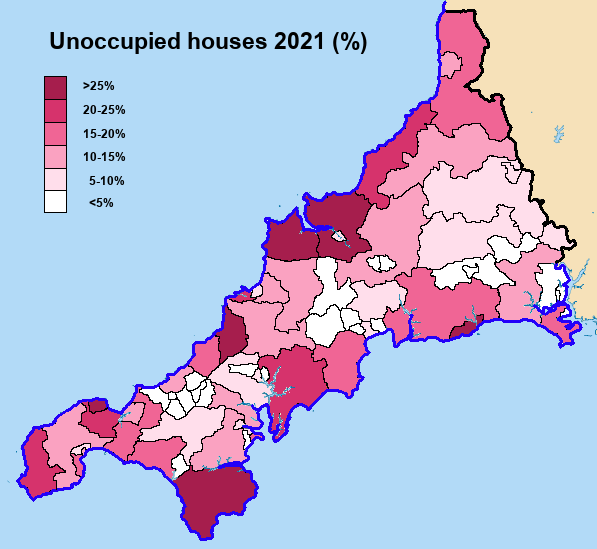
The authors conclude that the vulnerability to gentrification and housing commodification in Cornwall can give rise to ‘narratives of exclusion and resistance’ particularly attractive to Cornish identifiers and the young. They suggest that a Cornish national consciousness can be shaped by economic marginalisation as much as culture or ethnic affiliation. However, neither these potential narratives nor the nature of that putative national consciousness are explored in any detail.
In fact the authors seem a little unsure about what is meant by ‘Cornish nationalism’, which is equated rather unproblematically with local identity. Some confusion is also introduced by their second factor – political representation and shared history. This failed to correlate with the other three factors, which is hardly surprising when it yoked together two statements: ‘tourism helps to sustain Cornwall’s culture and heritage’ and ‘I feel that a shared identity brings us together’. Any self-respecting ‘nationalist’ would surely answer these differently.
In addition, does not the term ‘nationalist’ imply support for political action? In Cornwall, there may be grumbling but we have to yet to see disaffection with the way the housing system operates spill over into active expressions of support for MK or more spontaneous demonstrations either against overtourism or demanding housing reform as seen recently in Iberia.
Only when housing issues combine with cultural/symbolic elements will sufficient challenge be mounted to a housing and planning system in Cornwall that has been rigged for decades to favour better-off incomers over natives, residents and the environment. And all in the service of developers and others who have profited from cynically selling Cornwall off to the highest bidders while shedding copious crocodile tears over the need for ‘affordable’ housing.

