Catherine J. Frieman, ‘Local practices and global processes: Cornwall in the Bronze Age world’ in Heide W. Norgaard and Samantha S. Reiter, Bronzization: Essays in Bronze Age Archaeology, Archaeopress, 2025, pp. 28-39.
Archaeological models of Bronze Age Eurasia have noted that by 2,000 BC people in western Europe were sharing artefacts, rituals and most notably the use of bronze metal. Bronze (and metal in general) was significantly different from other resources such as wood, clay, flint or stone in that the constituent ores were only found in certain regions and had to be transported from those regions to others.
Such transport was at the heart of a proposed step change in connectivity and interaction during the Bronze Age. Archaeologists have therefore proposed networks of exchange across western Europe creating a ‘transculture’ of common cultural practices. However, within this there existed major centres or nodes of exchange. These were usually regions of ore deposits which ‘loom large’ in discussions of Bronze Age connectivity. In addition, most models of the period see emerging elites as the drivers of this exchange and connectivity.
Cornwall shared in these long-distance networks with some of the same domestic architecture, tools, ceramics and metalwork as were found in neighbouring regions. A few finds of exogenous artefacts are also evidence of participation in trade networks. Nevertheless, although there is also substantial evidence for the exploitation of copper, tin and gold in Cornwall in the Bronze Age it was not a major centre.
Cornwall was different in that these external links did not greatly impact on local cultural traditions. These were seen in pottery and the construction of rounds from around 1,500 BC while there were distinct funeral depositional practices – rarely with the single high status burials accompanied by the exogenous and rare objects that were found in other regions. This accompanied an absence of evidence for a ‘settlement hierarchy, coercive social control, or the emergence of an elite’.
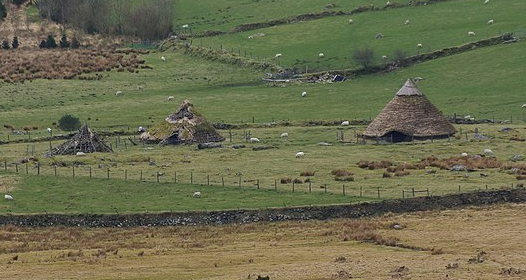
In challenging the wider model of the European Bronze Age Catherine Frieman observes that, in Cornwall the presence of significant metal working and extraction was not associated with the chieftains and political hierarchies of other mining regions. Cornwall’s metal trade was not controlled by elites. She suggests that in contrast it was managed by small settlements where life remained focused on domestic and pastoral everyday activities with metal mining and smelting being a seasonal activity.
The ‘low-control’ society that she claims to detect echoes the conclusions she and some colleagues reached in 2024 when they argued that in Cornwall the arrival of the Romans had a relatively small impact on local life.1 Moreover, this picture – of a decentralised society with limited hierarchies – might be further extended to the post-Roman period. Between the 500s and 900s there was no permanent kingship, light lordship, village and hamlet control of economic life and a dispersed ecclesiastical presence. (See my Cornwall’s First Golden Age.) All this closely resembled what we know of Brittany in the same period.
The implication that Cornish social structures had been dispersed, local and libertarian for 3,000 years from 2000 BC raises some intriguing questions. Does the arrival of the English take on more significance in breaking this long tradition? What had the precise function of Tintagel been during Cornwall’s first golden age if, as looks increasingly likely, it was not an elite centre? Can Cornwall’s libertarian social structures be traced into the later medieval period? Were such structures intimately connected with the Cornish language? As they say, more research is required.
- Aris Politopoulos et al., ‘An anarchist archaeology of equality: Pasts and futures against hierarchy’, Cambridge Archaeological Journal 34 (2024), pp. 531-45. ↩︎


An interesting analysis that runs counter to many narratives where a hierarchy is regarded as natural and essential. Does this suggest perhaps a more sustainable mode for society in the future?
LikeLike
Hey the Nebra Sky Disk was Cornish gold, and so were most of the Irish artifacts. I am convinced one of the first minerals rushes occurred in Cornwall about 2200 BC, which is when they picked up all the surface gold and copper. They just haven’t accumulated the evidence – for some reason no-one wants to look at Bronze Age Britain, maybe no grants.
LikeLike
I do agree that Cornwall was not in its early stages led by elites. I have argued that it’s geography with deep wooded valleys, rivers and a dividing moor was not conducive to and elite dominance. I do feel this may have changed when the Romans set up a “warlord” structure to act on its behalf when it left rather promptly to deal with problems elsewhere. And, regarding Tintagel, professor Ken Dark, who has studied Tintagel for decades is firm of the view that it was the seasonal or permanent base for a king-like structure. You are also probably aware of the term Pagus Tricurus (hope that is the spelling) for northeast Cornwall, Trigg region. Regards
Nick Cole Bude
Sent from my iPhone
>
LikeLike
Interesting. I agree with the point about geography and was tempted when revising Cornwall’s First Golden Age by the argument of a temporary kingship at the end of the Roman period (although never entirely convinced). But what’s the evidence for ‘a king-like structure’ at Tintagel in the 5th to 7th centuries? Have you a source as I have a few of Ken Dark’s books?
LikeLike
He gave a talk on CAS Zoom about a month ago when he said that he was convinced by his research and the nature of the finds at Tintagel that it could only be explained by some level of elite occupation. It is possible that the talk will be made generally available soon, as it was recorded.
Sent from my iPhone
>
LikeLike
No elites, but some people were selected for burials in barrows while the majority were not.
LikeLike
Good point. But ‘selected’ or self-selected by being wealthier? Or maybe rewarded by the community for their service? (cf the later Breton machtierns)
LikeLike